036/270: #Queensbury – The Roundabout

The parish of Kingsbury (035) had already existed for some time prior to the arrival of the Metropolitan Railway. Queensbury on the other hand was a completely new suburb. This is evident by the imposing nature of the station facade and grand avenue leading up to it.

This was suburban new-town planning on an even grander scale than metro-land. And what should be at the heart of every new community? A station – with attractive electric trains through to the city. An advert for families keen to move out of the cramped conditions of the inner city.

That ‘advert’ for the station still survives in the form of this attractive roundel beacon in the middle of Queensbury roundabout. What better way to marry car and train.

Image copyright A Carter – CallingAllStations.co.uk
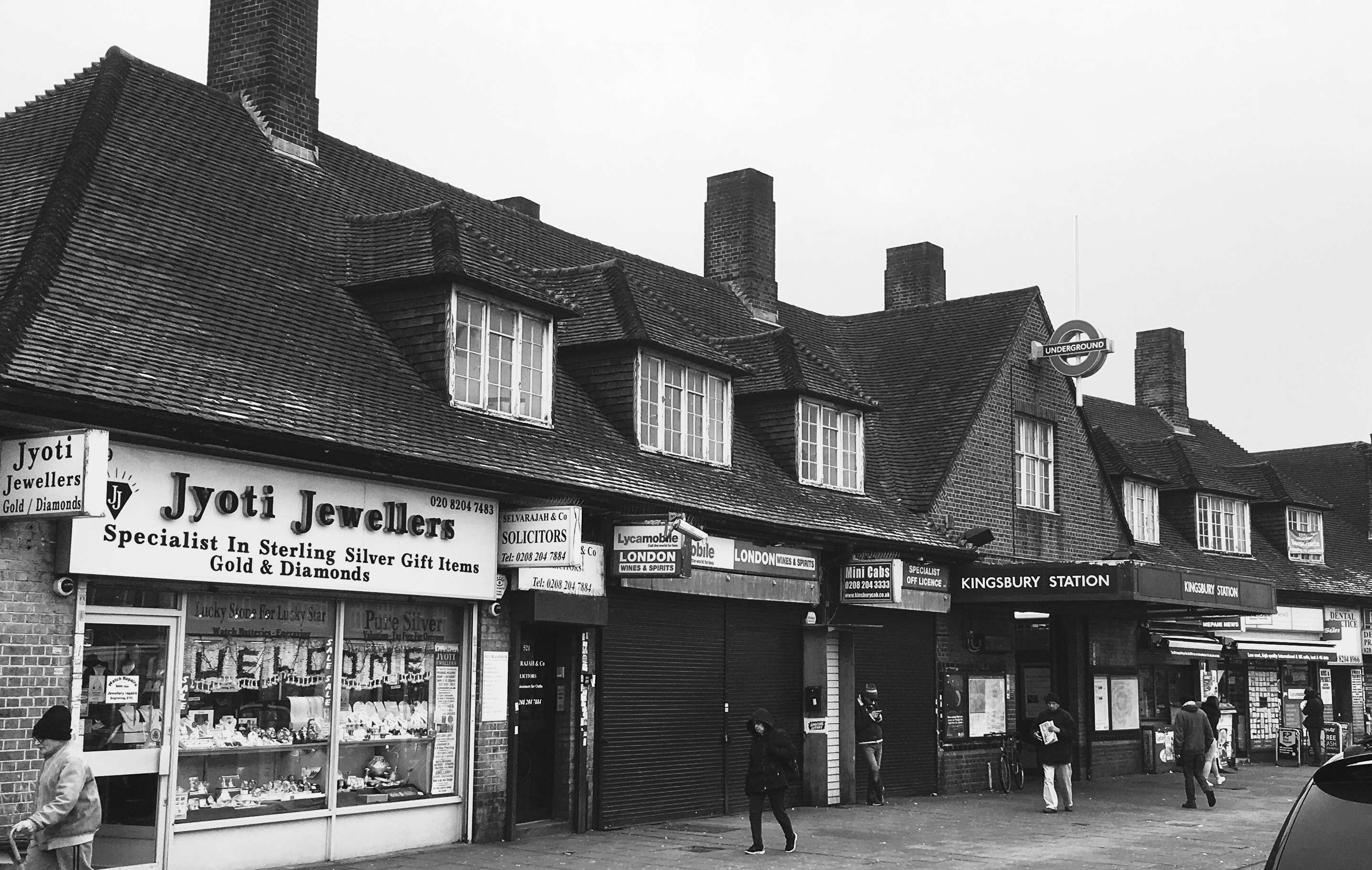
035/270: #Kingsbury – The Impersonator 

Kingsbury was built with the Stanmore branch in 1932 by the Metropolitan Railway. It’s a clear departure from the Art Deco styling of the decade that we’ve been so used to seeing elsewhere on the network. It wouldn’t be until 1939 that the newly formed London Underground would absorb the Metropolitan Railway; so at this point their station design was still largely independent of the growing uniformity of the UERL Pick-Holden partnership.

Instead the Metropolitan Railway favoured mimicking the earlier 1920’s Arts-and-Crafts movement as seen at Watford and Croxley, both built some 8 years prior. This isn’t surprising, even though architectural tastes had moved on, brand image and identity was important to Railway companies. It is comparable to the practice seen after World War II when many Holden designs resumed construction even though popular tastes had perhaps moved on.

Sadly the station building at Kingsbury is somewhat neglected, with part of it’s commercial space clearly lying empty. One has to wonder what control, if any, TfL still has over the property and whether it will ever be restored to it’s former glory.

Image copyright A Carter – CallingAllStations.co.uk
034/270: #DollisHill – The Dolls

Station 34. We’ve seen Green. We’ve seen Holden. We’ve seen unexpected architecture, both good and bad. We’ve seen mosaic cats and black horses and we’ve seen cathedrals and flying saucers.

It’s fair to say we’ve seen a lot. But nothing will prepare you for what we saw at Dollis Hill.

Dollis Hill’s surface existence is fairly apologetic. It’s more of an alleyway between two residential streets than a station entrance. The area is a bit grubby, but hey, we’re opening our eyes to all that London has to offer, warts and all. (Although this is definitely on the wart side of the spectrum). Cast your eyes on the house on the right and what lies in the windows…

There’s a hell of a lot going on in this image, not just the EXCEPTIONALLY CREEPY DOLLS but the “Beware of the Cat” sign, the graffiti, the driveway full of rubbish, the decaying house and the opened box of matches on the wall. One has to assume the owner of this house has a crooked sense of humor, is mad, or both.

They say a picture can paint a thousand words. This one paints a thousand questions.

Image copyright A Carter – CallingAllStations.co.uk

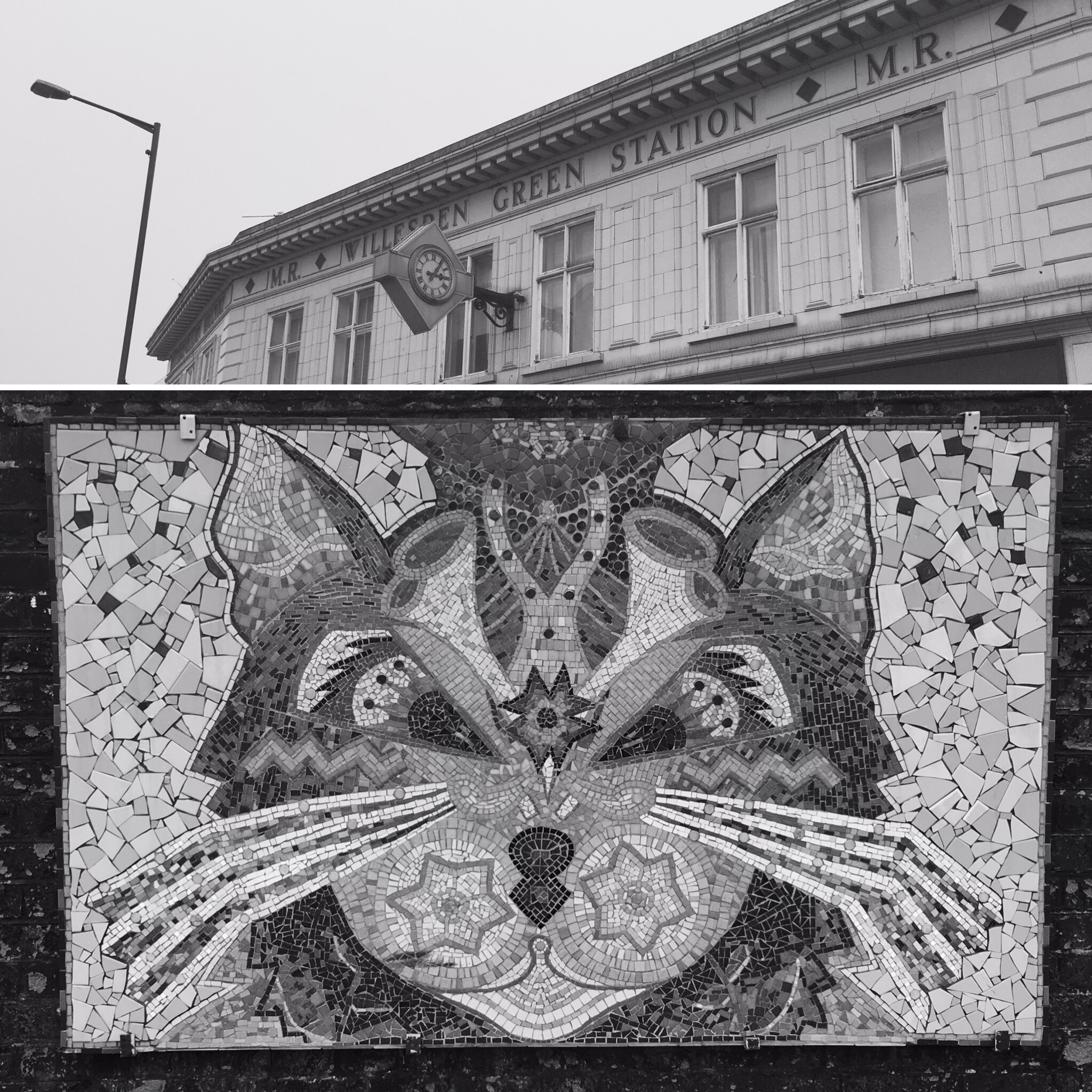
033/270: #WillesdenGreen – The Louis Wain Cat

I’ve never been to Willesden Green before, and had it not been for this challenge then I wouldn’t have discovered the works of Cat Artist (yes you read right), Louis Wain.

Wain moved to the area in the mid 1880’s with his wife Emily who was suffering from breast cancer at the time. As Emily grew sicker, she would often be comforted by a rescued stray cat called Peter. Wain started to use Peter as inspiration and began sketching him and other feline portraits. Emily encouraged Wain to publish sketches of Peter but she sadly died before this became a reality. After her death, Wain continued what would become an obsession with cats (and who can blame him… cat’s are awesome), which saw his work take on a range of disciplines, including anthropomorphism and abstractism.

None of this I would have discovered had it not been for a mosaic homage to Wain sitting opposite the station. The striking tribute was put together by the local community group Willesden Green Town Team led by Debra Collis.

Image copyright A Carter – CallingAllStations.co.uk

032/270: #Kilburn – The Shoot Up

Kilburn sits on the curiously named Shoot-Up Hill. It conjures up the image of highwayman hold ups and dueling gangsters doesn’t it?

Sadly the name is thought to originate in the topography of the landscape as the old Roman road suddenly “shoots up” a hill towards Cricklewood.

Well that was disappointing wasn’t it. I suppose we better get back to the trains…

Image copyright A Carter – CallingAllStations.co.uk