Langstead – Episode 15: Test Runs

Following on from Episode 14 I now have all the required extra bits of track to complete the new outer oval.

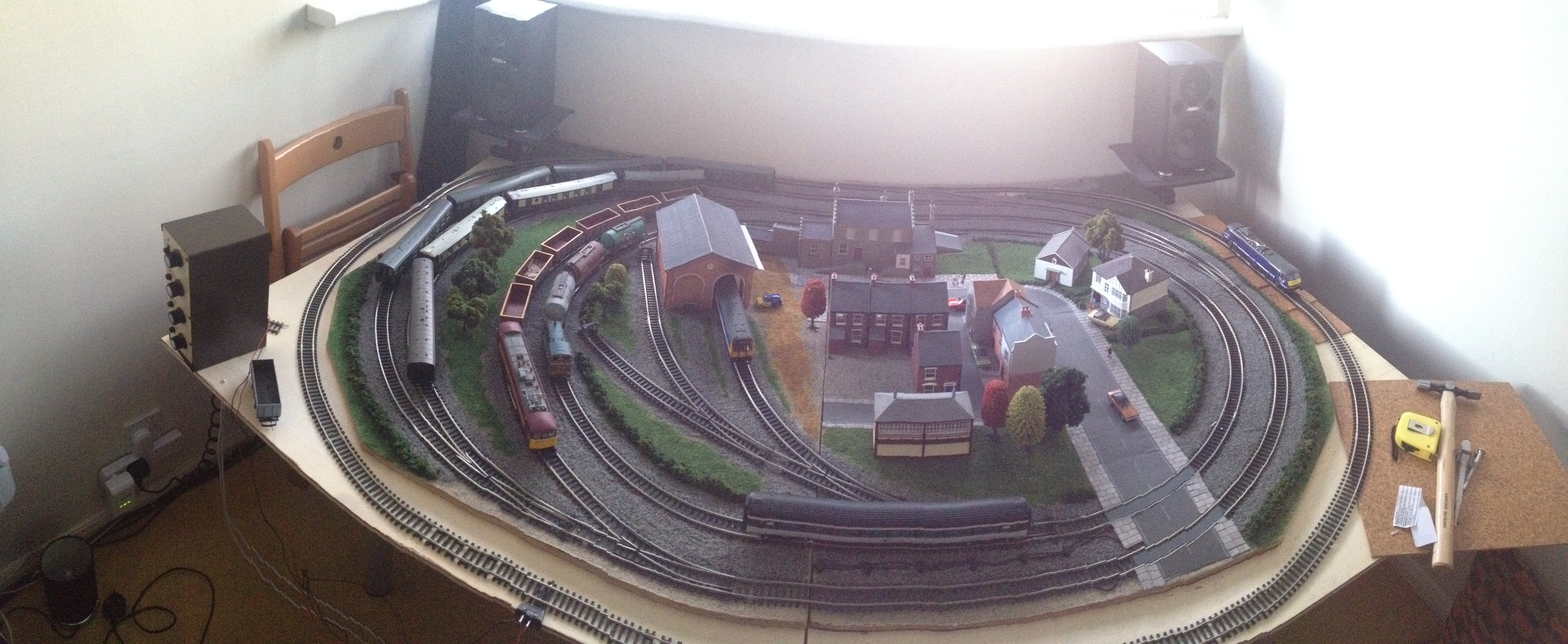
IMG_2193

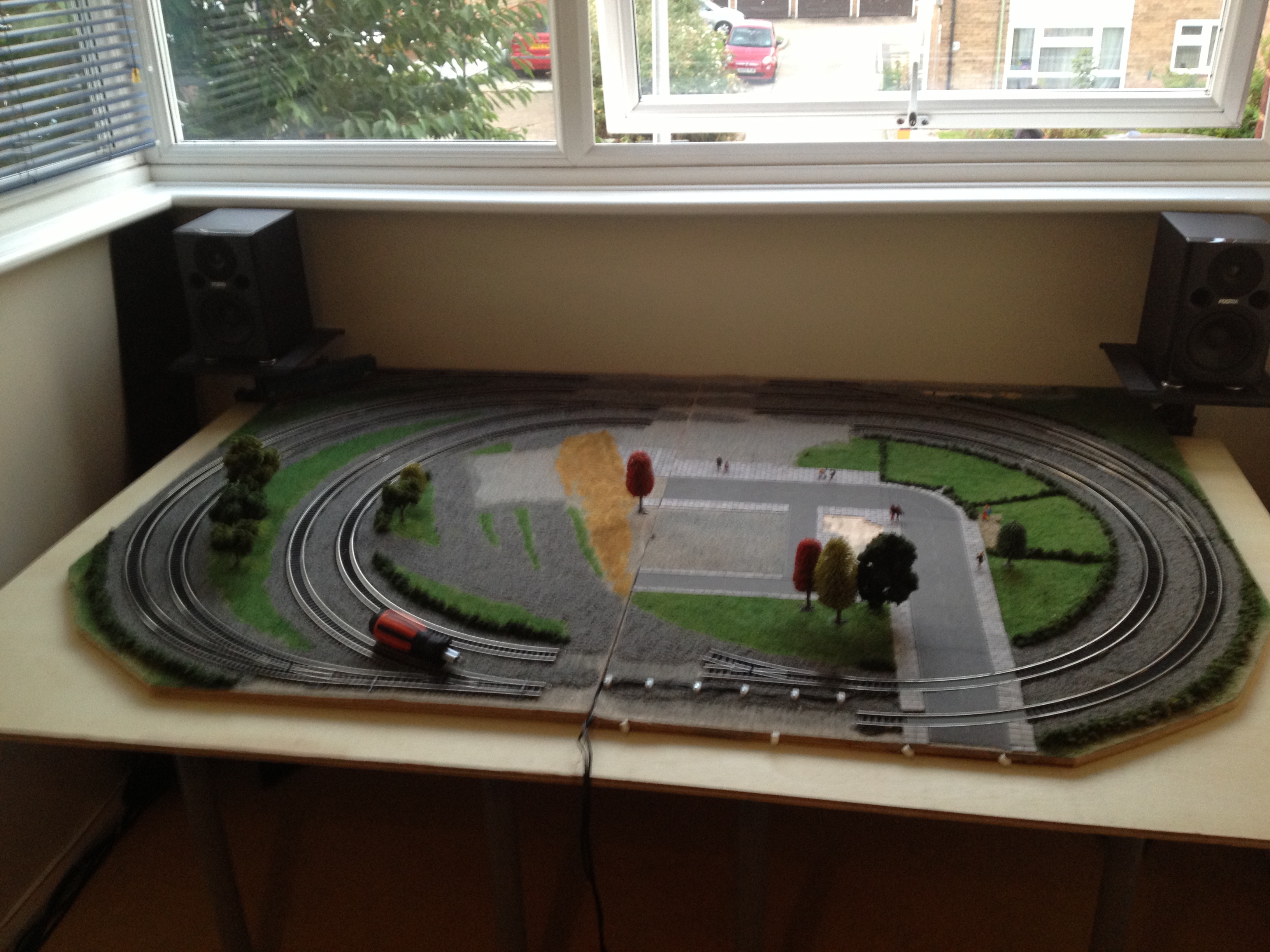
Here’s a rather suspect panorama (thanks to iOS7) of The Mainline with the additional oval.

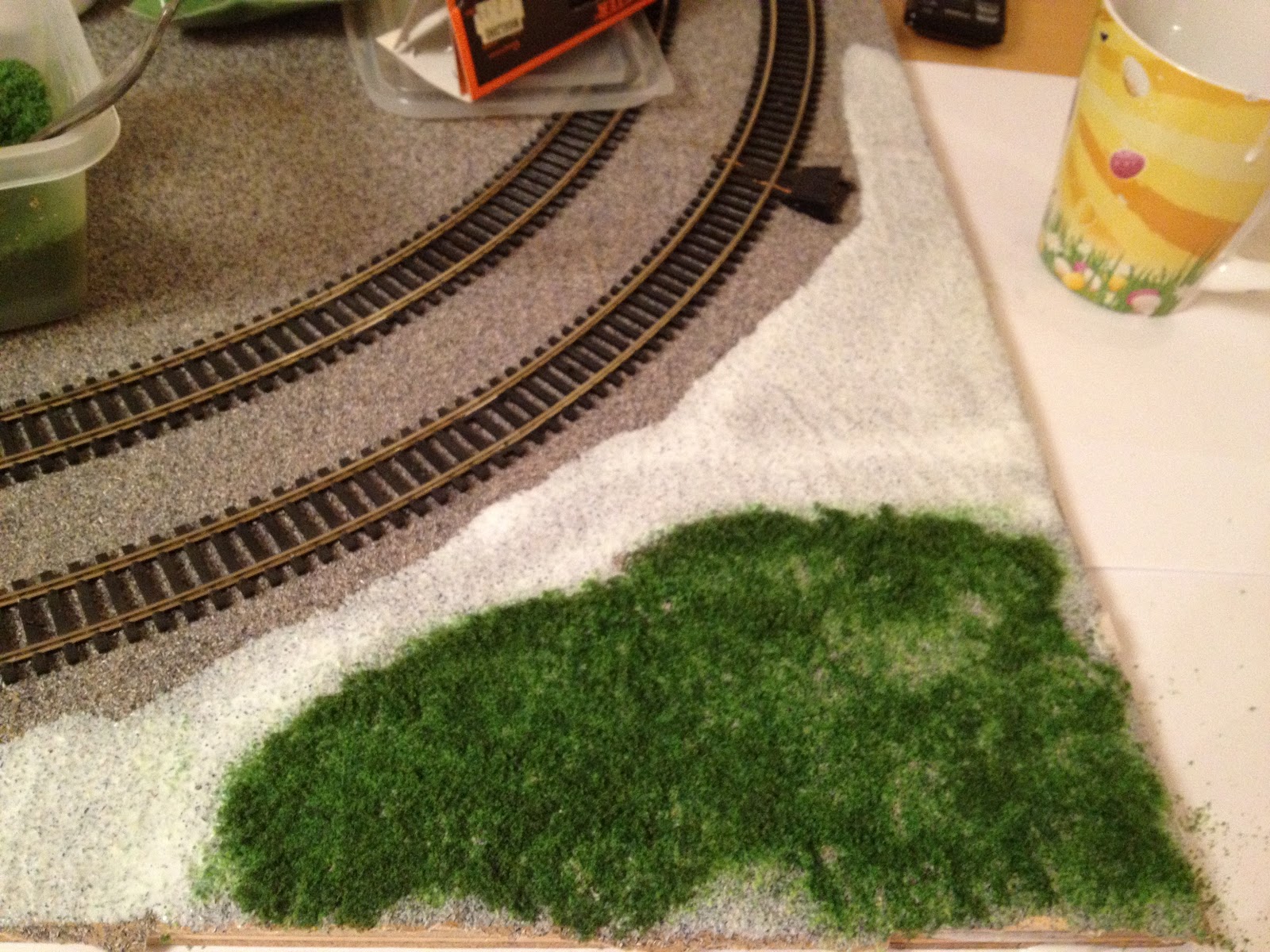
It’s hard to spot in the picture above but at the rear of the layout the oval runs on the old boards and at the front it drops down and runs on the new woodwork. This means either side must accommodate a modest gradient to raise and the lower the line between the sections. Continue reading

Langstead – Episode 14: Extensions

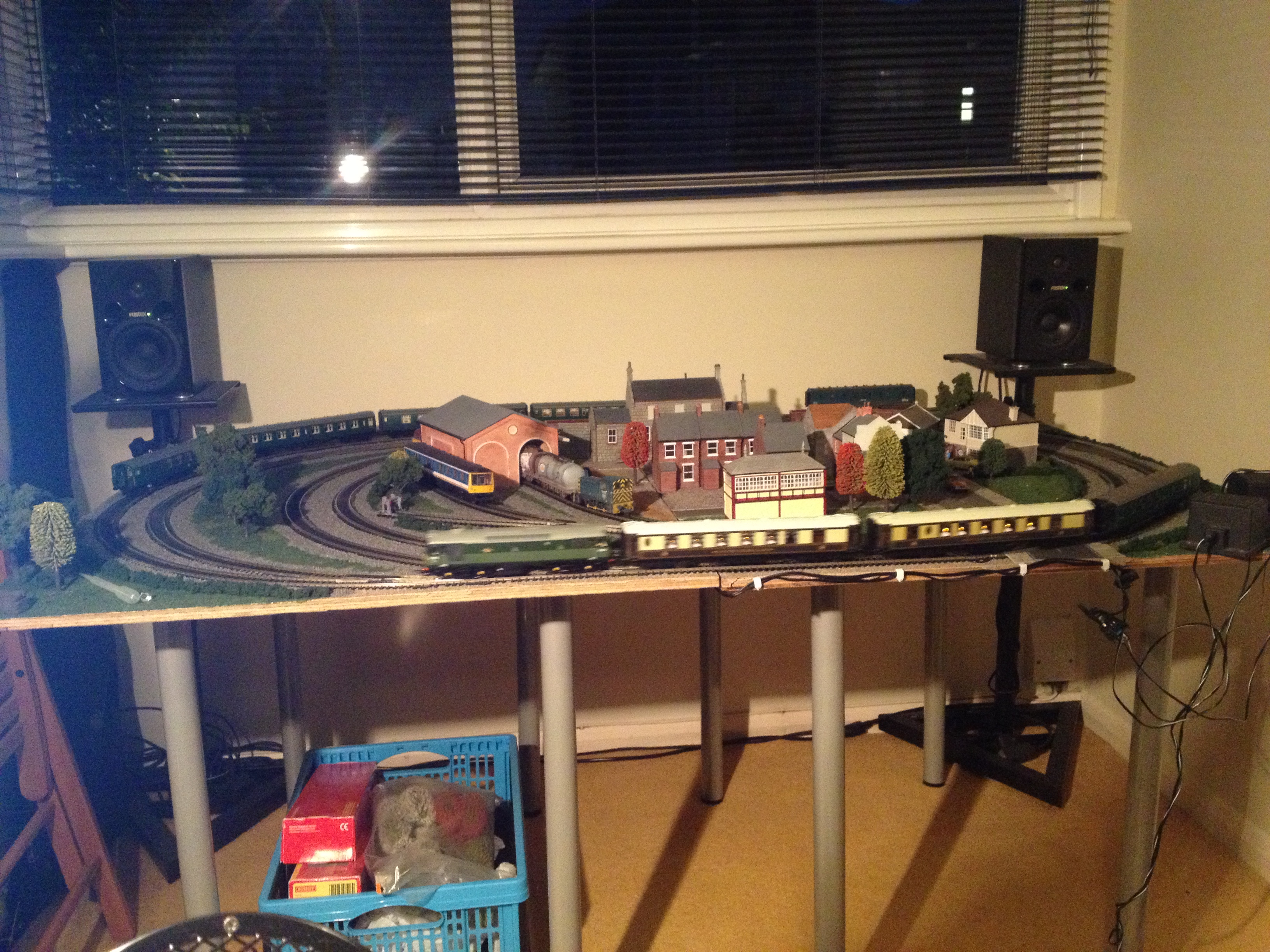
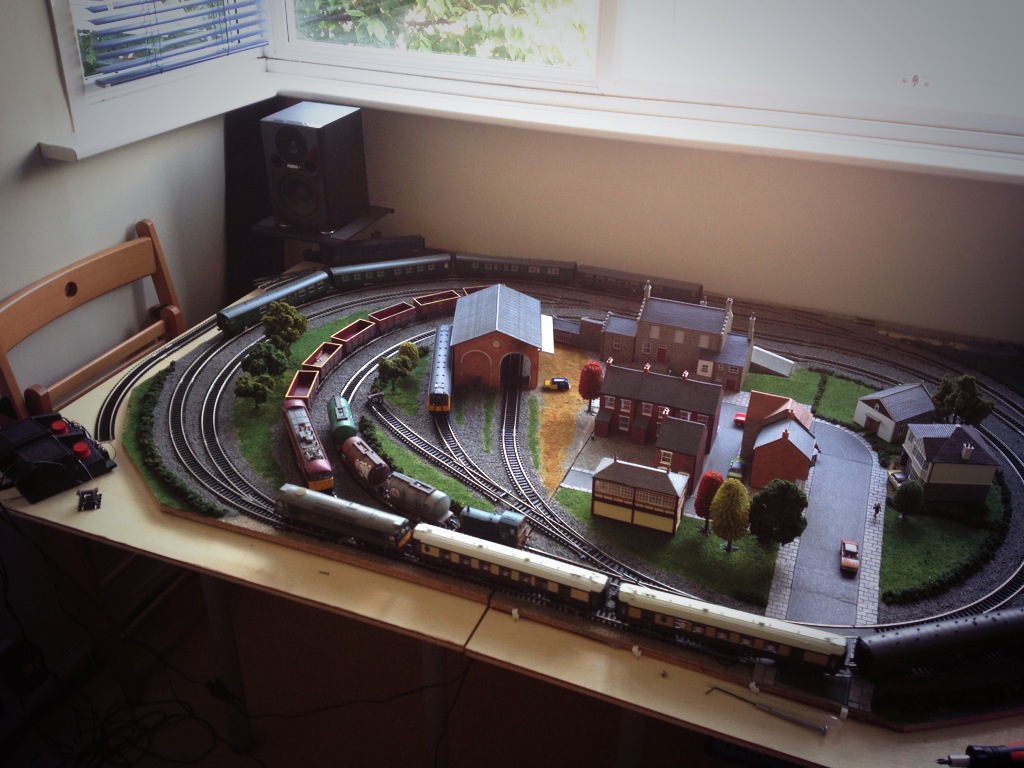
The Mainline as of August 2013

The Mainline as of August 2013

I promised myself that once I moved into my new flat I would in someway look at expanding my layout, now known as ‘The Mainline’ for sake of giving it a fancy title for this new site.

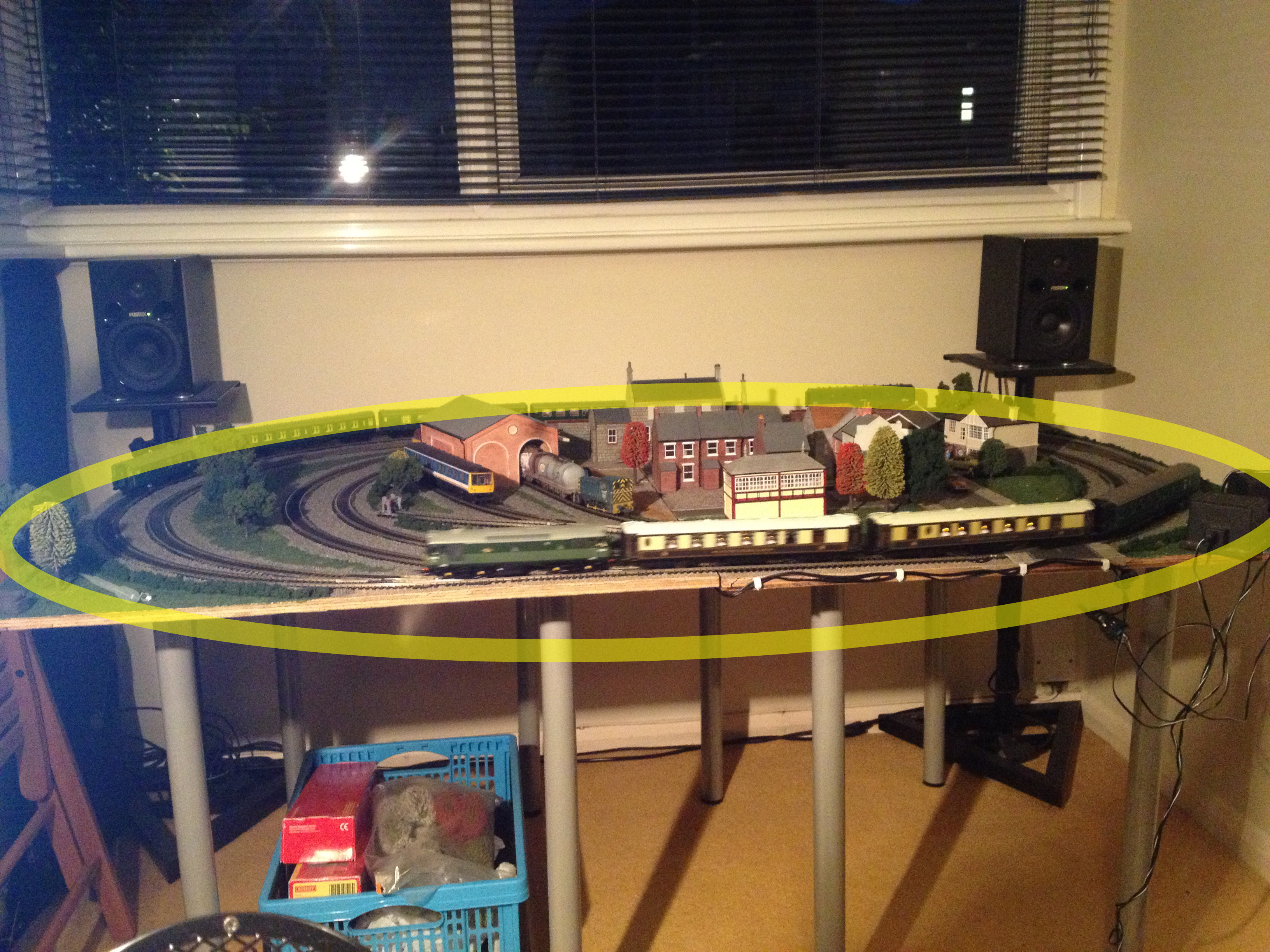
Possible areas to expand into marked in yellow

Possible areas to expand into marked in yellow

Now, I’ve not got acres of extra space to work with: Either side on the left and right there is perhaps 10-12 inches of spare room between base board and wall. Nonetheless I think it’s just about enough to think about an expansion in some way.

Option 1: Split and Insert

Option 1: Split and Insert

First idea is to separate the two boards, move them both into the yellow zones and insert a new board in the middle where the red line is. You may remember that my original design factored in this potential method for expansion.

No major track work will need to be done, it’s just a case of adding another straight to each oval. It will be slightly fiddly to plug the scenic gap but nothing too difficult. The major problem with this plan is the two speaker stands at the back of the room. Currently the baseboard nestles snugly in between them both and are flush against the back wall maximising space. If I were to separate the two boards to add a new piece I’d either have to move the speaker stands completely, or, bring the entire layout forward (and off the back wall) to accommodate the expansion. I don’t like the sound of either of those two plans.

Option 2: Expand on the left hand side only.

Option 2: Expand on the left hand side only.

Second idea is to expand in one direction only. In this scenario a terminus station or yard could be considered for scenic and operational interest. I’ll be honest, this was my preferred idea for quite sometime… I’ve since discovered that I much prefer sitting back at my desk (where these pictures are all taken from) simply enjoying running various trains. I’ve found I’m much more likely to do this rather than sit at the layout itself and make lots of complex operational changes… after all, that’s what Salford Chapel is for… The Mainline has become much more an outlet for running trains whereas Salford Chapel is becoming the more detailed ‘model.’ Therefore, maximising the number of trains I can run would be priority in this expansion project. The station or yard option above would allow me to switch stock around however I’d definitely have to look at motorising points so I’m not constantly leaning over the entire layout all the time. (I’ll admit this gets a bit irritating).

Option 3: Elevated Line?

Option 3: Elevated Line?

Option 3 is a bit… out there… Build a completely new oval, elevating it above the rest of the layout. I really like the idea of adding height and it’ll mean I’ll be able to run a 3rd train at any one time, but logistically I really don’t know where to begin in making it a reality. Far too complicated.

Option 4: An outer oval.

Option 4: An outer oval.

Same as Option 3, but less wacky. There’s a relatively unused siding at the back of the layout. I could essentially develop this into another full outer oval, expanding in all directions but hopefully in such a way that I won’t have to move the speakers or take up too much room at the front of the layout. Now we’re talking!…

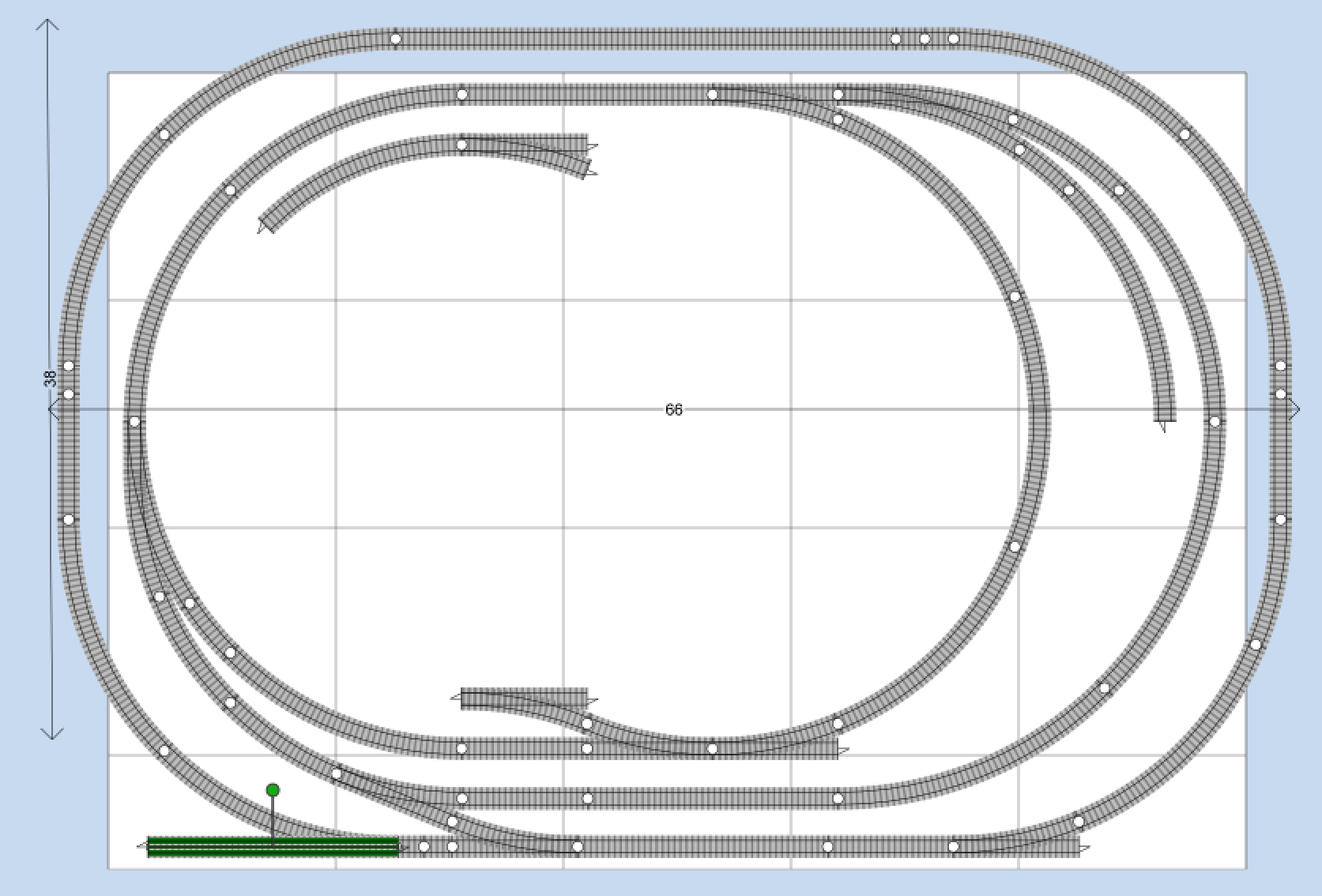
The Outer Oval

The Outer Oval

Ignore the fact there’s some track missing from the above layout on the inner ovals, this is because the free version of the AnyRail5 software I’ve used only allows 50 pieces at any one time. The green piece of track at the bottom will need to be lifted to make way for the outer oval curve. Overall the layout will expand only 3 inches at the sides and 3 inches at the front, but will allow the operation (and interest) of running a 3rd train.

Now I could add braces to the underside of the original baseboard to support a 3 inch strip of wood all the around the layout. However, I thought it would be far easier to buy completely new boards, slightly wider than the old ones, to accommodate both the new oval AND the old boards themselves…

Lifting Track

Lifting Track

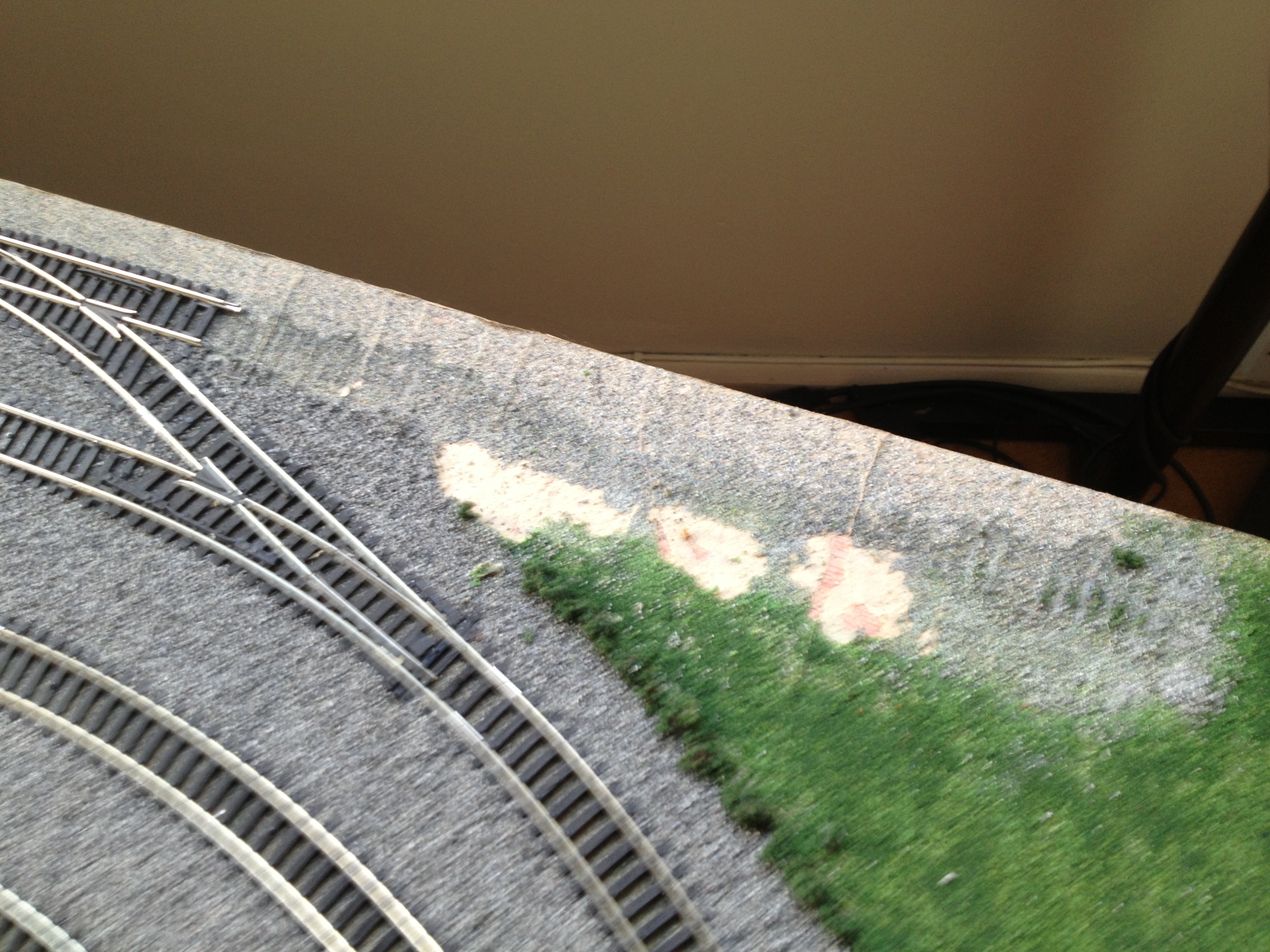
First job was removing the redundant siding at the back of the layout. Old ballast was chiseled off and the section of track lifted. I’m not worried it left a bit of a mess, I’ll model over this in good time.

Deforestation...

Deforestation…

...Is required

…Is required

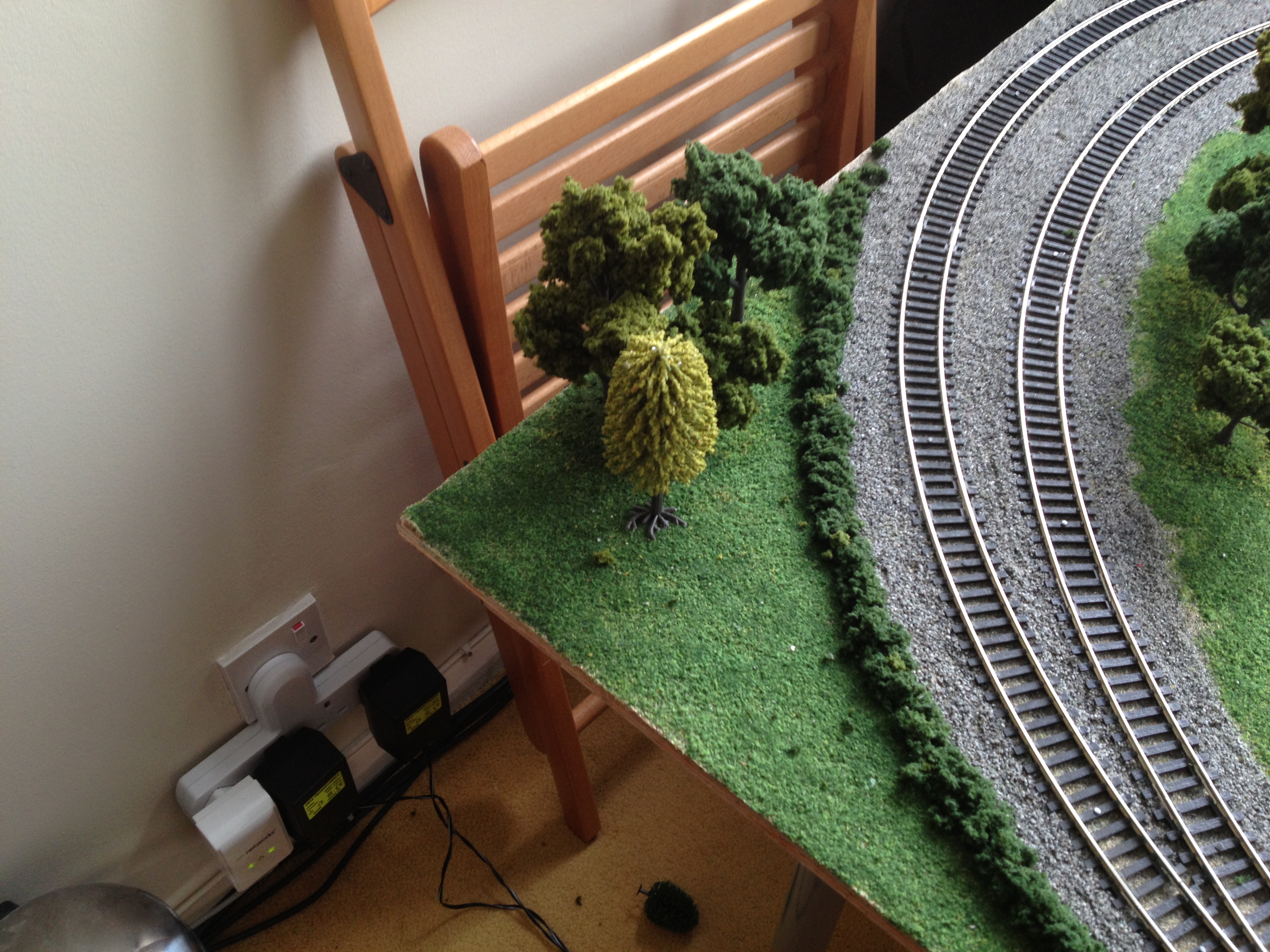
Corners of the board were sawn off to make way for the outer oval.

Changing Legs

Changing Legs

Legs and leg plates were removed from the old board and added to the new ones. See Episode 17 for this process!

Old on New

Old on New

The old boards were then laid on the new ones now clearly showing where the outer oval will eventually go. It’s worth noting that they are still in two parts – to enable dismantlability, and still leave room for the speakers to remain in place at the back of the room. There’s also a height difference between old and new which will add some much needed depth to the layout. Gentle gradients will rise and fall from the old siding at the back of the old boards to accommodate this.

Buildings reassembled!

Buildings reassembled!

I’ll be off to ebay now to get some more track! Stay tuned for results soon.

– Andy Carter

Salford Chapel – Episode 1: A Side Project

As you may be aware I’ve been toying with the notion of a side project, based upon the inspiration of some of Epping Railway Circle’s end to end (or shelf – this will become an important word later on) layouts, like this one…
So far my current layout has developed from concept…
To construction…
To something that really is starting to look rather good.
If you track back to Episode 2, you’ll remember I set myself the task, amongst others, that my layout should be easy to set up and set down. This was, at the beginning, achieved successfully. However as I’ve done more, and added scenery and buildings that can be plopped down the set up and set down time gets a little longer each time. In reality there is never going to be a fast and easy solution to setting up and setting down any model railway that isn’t a permanent fixture. Especially as in my case I’m quite particular in making sure all the trains go back into their correct boxes (must’ve inherited this trait from my Dad) and all the buildings are stacked such that they’re not going to damage each other in storage. 
Now, this isn’t as big a problem as I’m making it sound. I actually quite enjoy the fact it takes a bit of time to get everything set just so. Equally as sad I also enjoy making sure everything is packed away in it’s appropriate place too, right down to putting the boards back in the cupboard; it makes me feel like I’ve successfully achieved some of my targets of this project.

What I will say is, that because setting up and setting down is a now a more lengthy process I feel more obliged to get the layout out when I know I can dedicate a weekend, or a run of days off to its use and continued construction. One day, this will not be a problem when I hopefully don’t have an as busy flat and have maybe some more space at my disposal. It would be really great to have something much smaller that doesn’t need a weekends dedication…

Don’t get me wrong, this is not an abandonment of my original project by any mile, quite the contrary, as I have some updates for you on that front from what I have worked on recently. This side project is also a chance to explore making a more of a model scene, rather than somewhere to enjoy running all the various trains I like. By this I mean there is more potential in a smaller shelf layout to explore things like setting, era and theme. After all, on an end to end layout it’s not possible to set a train going purely for the enjoynment of watching it run. The enjoyment in a shelf layout is different – there’s scope for operational planning, shuffling wagons about mimicking real life scenarios.
So here we go, rather than taking months to tell you where I’m up to on this project, most of the techniques I have already done so rather than taking months to explain where I’m up to, I will update you more swiftly…

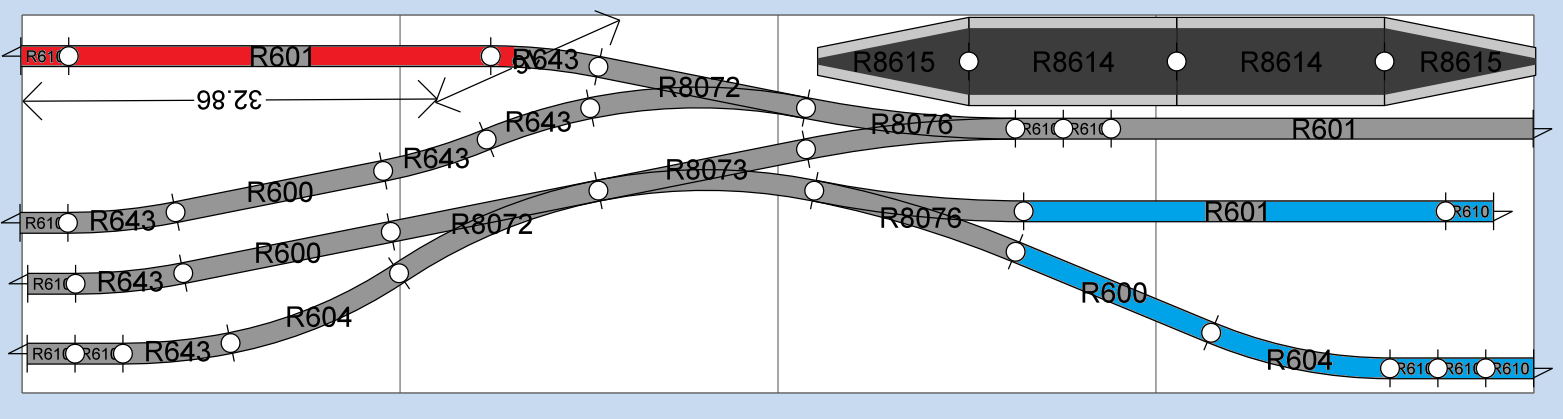
Here’s the design. I agonised over this for quite a while, and maybe there is scope for a separate blog of how many versions of this plan I went through until I got to this one…

The dimension is 120 cm x 30 cm, why will become clear shortly.

It will feature:

  • A small terminus station, which could either be a rural location of forgotten inner city branch.
  • A number of sidings and head shunts. These will all comfortably accomodate a 2 car Pacer DMU or a tank loco + coach by design, meaning I can give this either a modern or historical setting, or preferably something neutralish so I can chop and change.
  • An out of sight ‘fiddle yard*’ (the red line) where trains will appear to vanish up the main line and into a tunnel.

*Fiddle yard is a term used by model railwayers to describe a set of sidings or track out of sight from the rest of the layout. They are usually un-landscaped and hidden in such a way to maintain the illusion of a setting for the rest of the model.

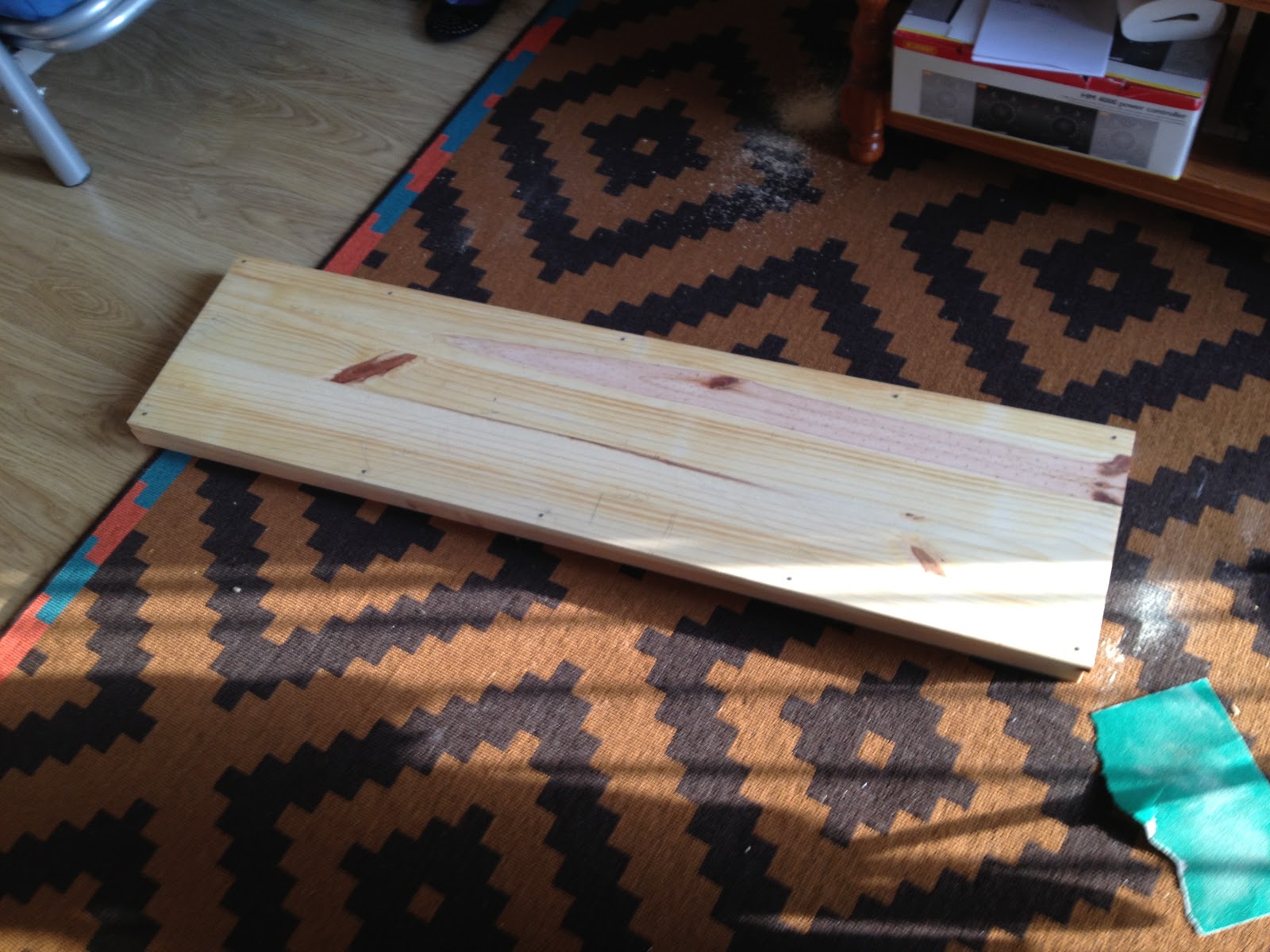
A trip to B & Q and I come back with this. It is, rather unsurprisingly, a 120cm x 30cm pine untreated shelf. (Shelf being a key word remember). This will act as my baseboard.

The track fits on it thussly…
You’ll be wondering why these dimensions?
My desk is exactly 120cm long, as is my coffee table (nearly). It’s also relatively small and inoffensive so storage is going to be no problem at all, but it’s going to be easy to move about and I can plonk it in more places when in use.

 
This time I wanted to explore the use of motorised points. Therefore I’ve raised the baseboard up by putting it on a ‘frame.’ And by ‘frame’ I mean two pieces of strip wood. I nailed the shelf to these.
Completed baseboard on frame.
I can confirm that pine will accept track pins with ease, as will it accept drilling: to come later…
I have however elected to lay down some cork on top of the baseboard which will hide the nails of the frame and also provide a uniform surface for everything else going on top.
Some modellers will find proper cork sheets. Me? I’m using floor tiles. They’re even slightly laminated which will later prove helpful when sticking things to it… They’re also rather brilliantly (roughly) 30cm x 30cm meaning I’m not going to have to cut a great deal!
PVA glue (100% as opposed to a mix with water) will do just fine here.
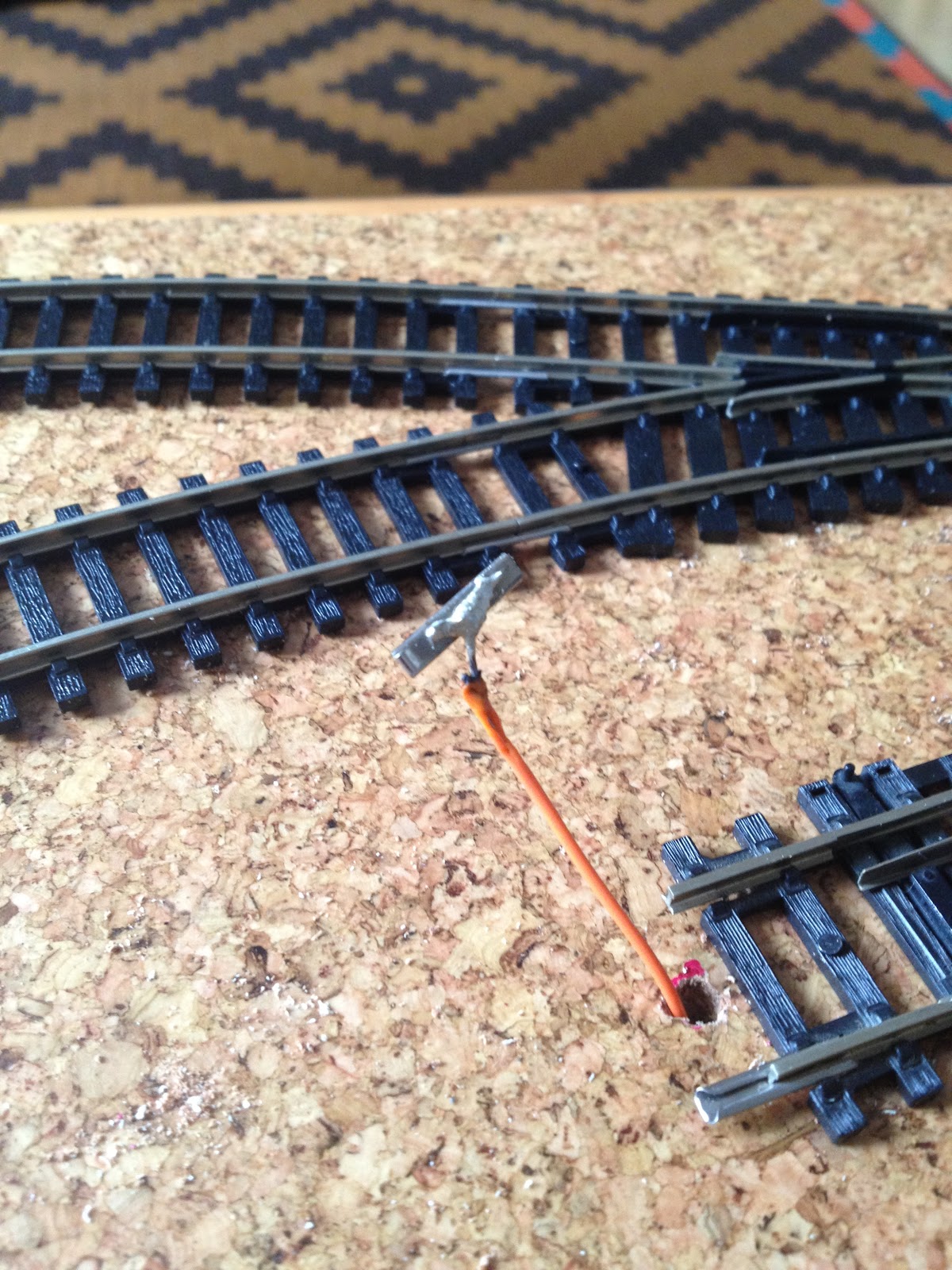
This time, whilst laying the track, I have drilled holes as I go for track power supplies and points. A good tip I picked up on the forums was to pre solder power supply lines to the fishplates, this will help you not melt the sleepers as I did in my other layout…
This partly worked… It would have worked better if I wasn’t using utterly rubbish solder but it did involve snapping off a bit of sleeper from some track which you’ll see in following photos.

Once this was all complete I added some point motors.

Now, I could take up a whole blog talking about point motors. They come in a variety of flavours and costs. Most modellers will opt for something that is fitted underneath the board, some even go the whole hog with wires and pulleys mimicking signalling systems of days gone by.
As this is my first go, I’ve opted for surface mounted point motors. Peco PL-11’s to be precise. They are really simple to fit – simply latch onto the side of your point and nail down. A small hole will be required for the wires to disappear under your board. (Hence the frame). Most modellers will opt for something more discrete but this is my first attempt after all.
Again you can go and get really cheap switches but I’ve elected to get the more expensive Hornby ones. This was in part because they give a much nicer, and more authentic, signal cabin lever experience but partly because they are much easier to wire.
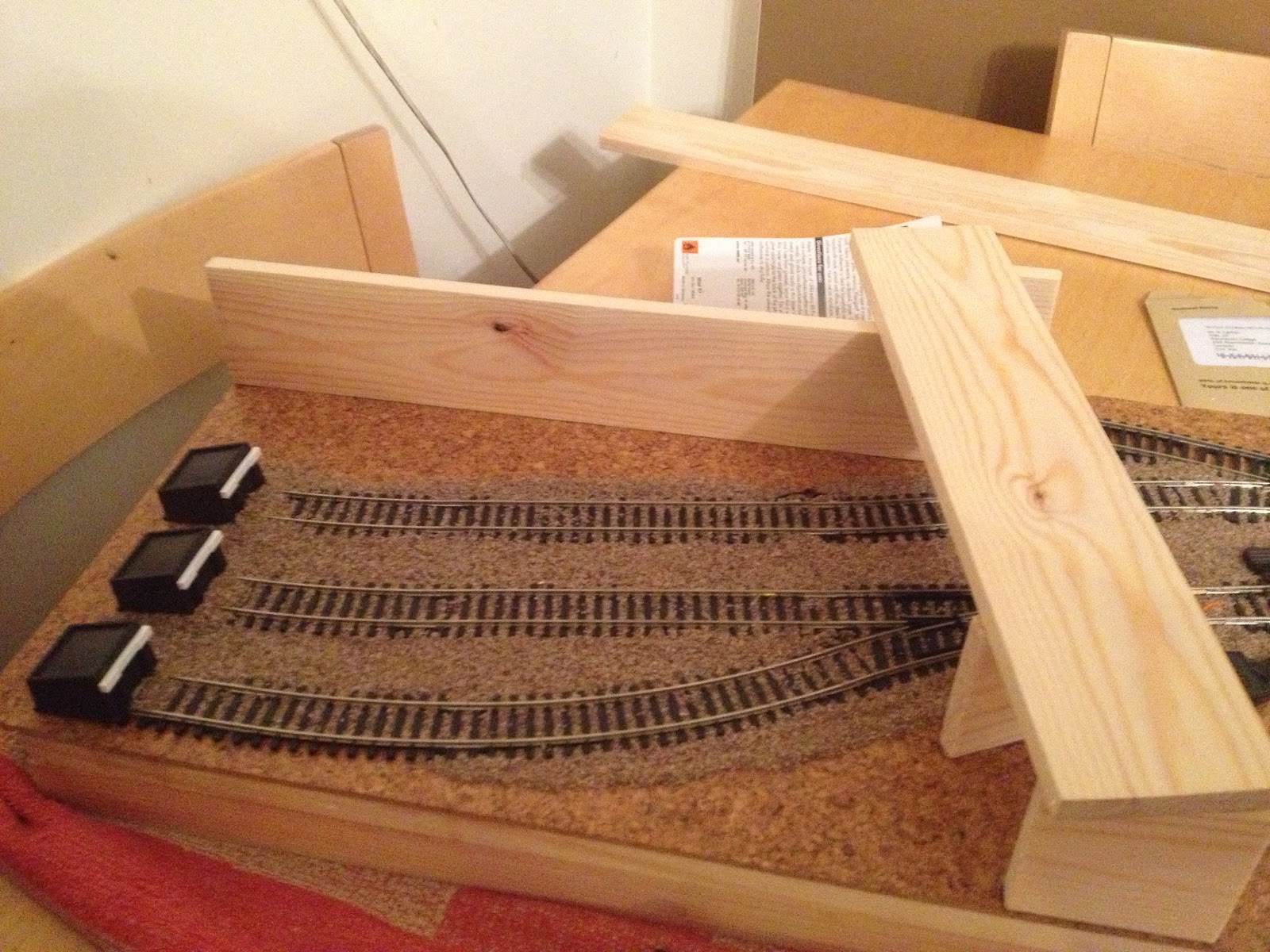
I could go into much more detail, and maybe I will do a dedicated post about the point wiring  at some point, but essentially for PL-11: You connect the red and black wire to the switch. These dictate which way the point sets. You then connect all the green wires (these are your commons) to one side of your power supply. The other side of the power supply feeds power to the switches. In the above picture, this one is brown, but it quite hard to see.  Again, I will properly explain this all at some point. There are also good places to go to explain how to do it… Like here

Rather excitingly, all the points worked straight away! Very pleased with myself.

Wiring takes shape underneath.
Next up it’s time to start adding some ballast. Check out This Episode for a more detailed breakdown.
I’ve used a slightly different colour than before. I’ve also stuck down the platform and buildings here using some super glue.
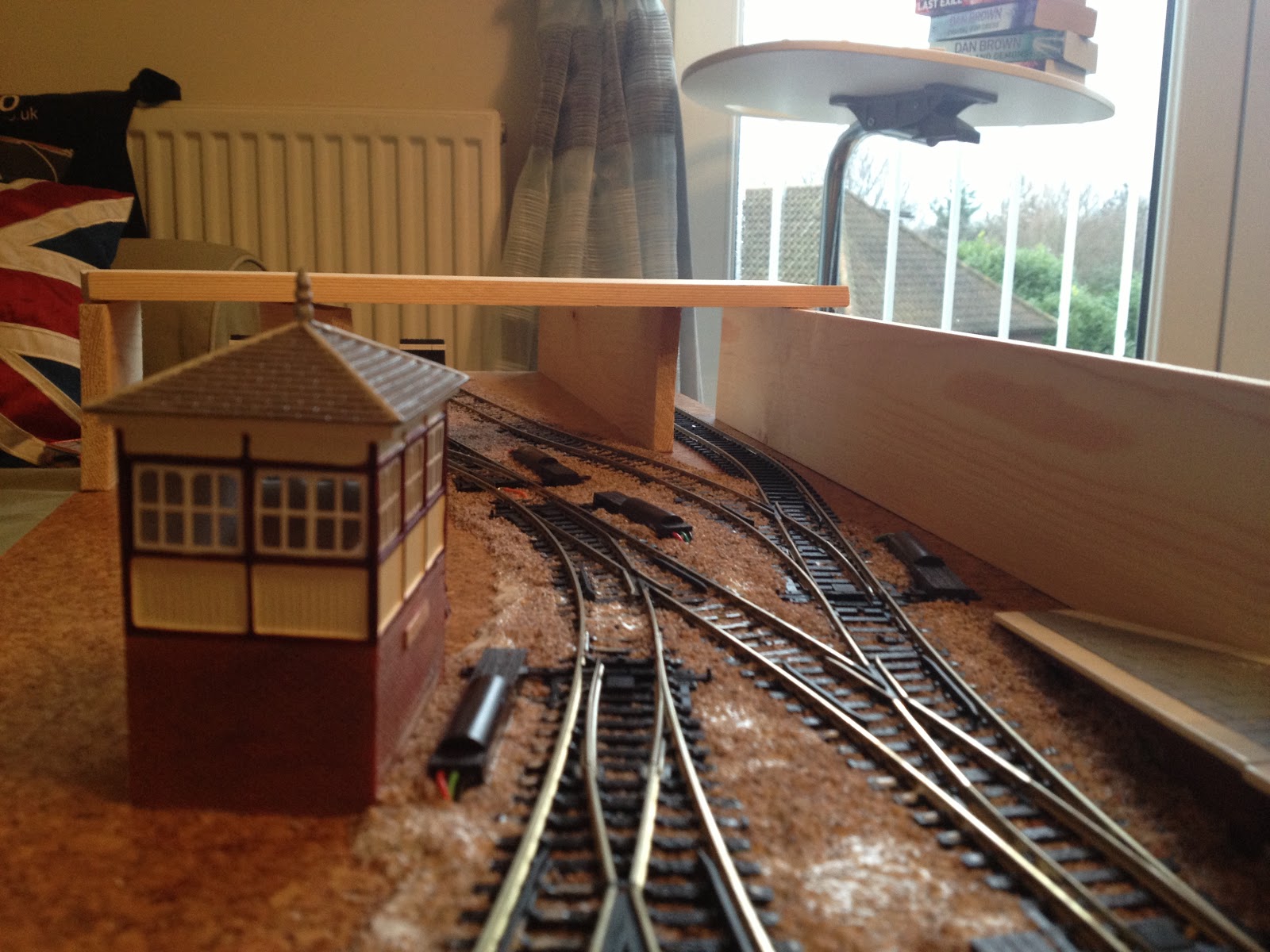
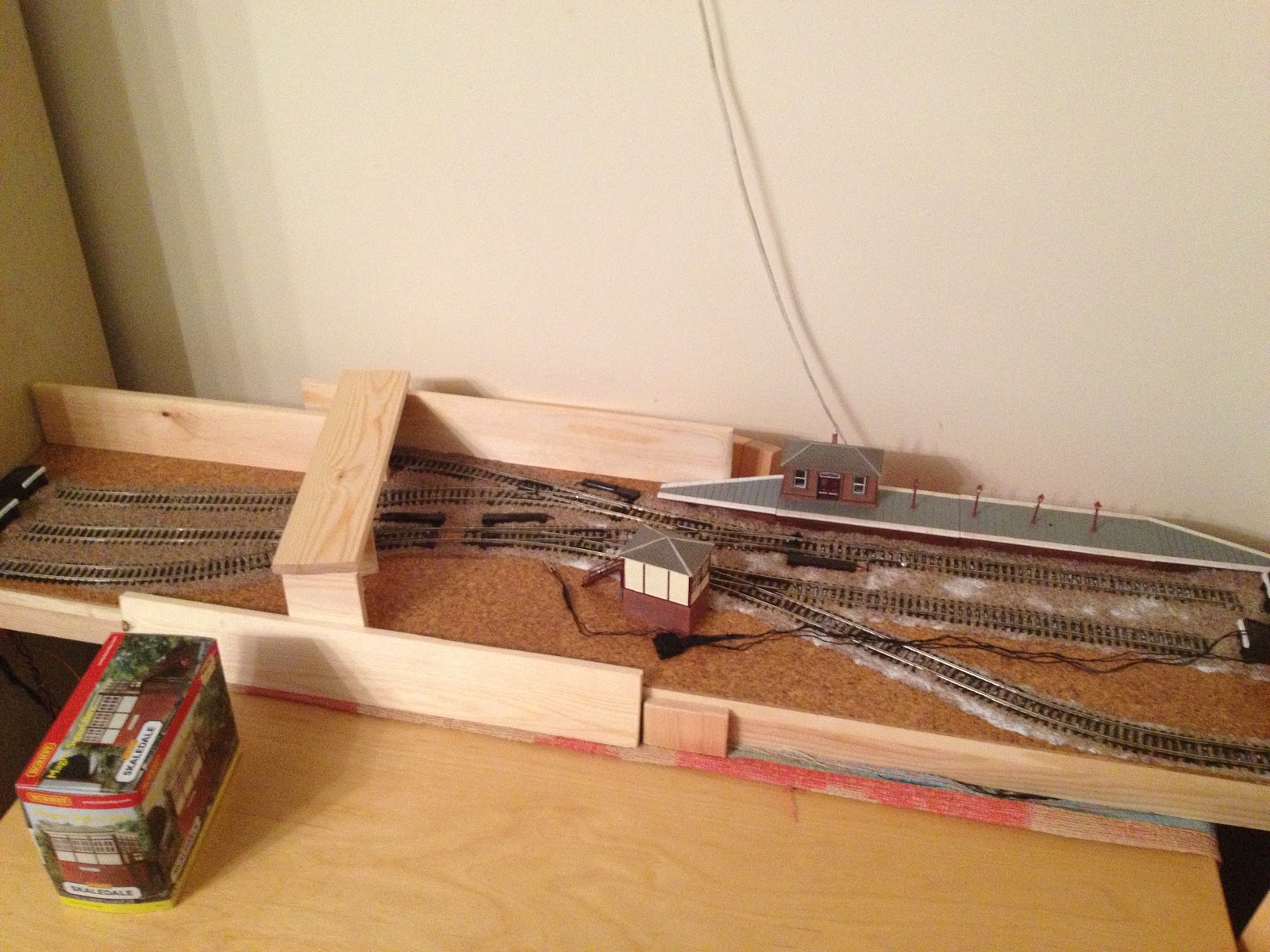
After another trip to B & Q, I’ve obscured the fiddle yard using some strip wood. I’ve also taken the opportunity to build a bridge for some added scenic interest. (I’m going to talk more about the decisions I’ve made on the landscaping in future blogs).
Another view, the mainline disappearing into the ‘tunnel’ on the right. Cleverly hidden by the strip wood.

And that’s where we’re up to!


Langstead – Episode 11: Powerrrrrrrr

As the great Jeremy Clarkson once said, ‘Powwwweeerrrrrrr.’
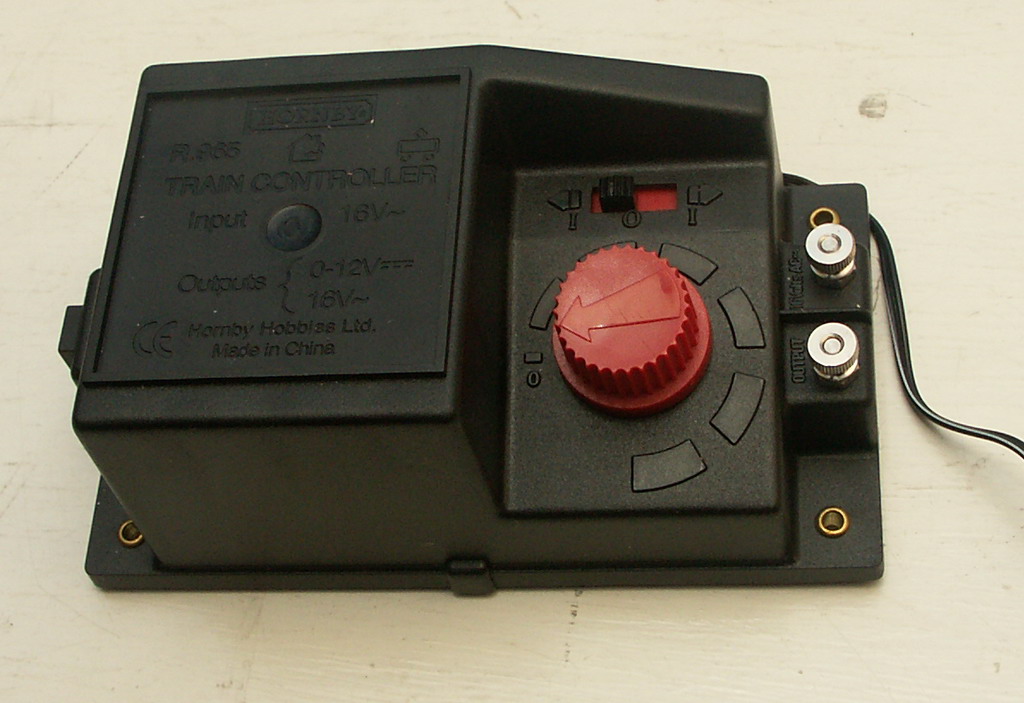
Back in’t’day… there was only one way to power your model railway. A good old Analogue potentiometer took care of business. You can go faster. Or you can go slower. One train and one controller per track. Simple. 
More recently however the model railwaying world has been taken a storm by DCC (Digital Command Control). I’m not going to go into detail, because you can catch me chatting about DCC in Side Tracked 1 of this blog, but DCC allows for multiple trains per track, plus an array of extra such as lighting and sound via one control unit. Sounds great, but it is more expensive and you will have to convert your existing locos with special decoder chips.
One day I will invest in DCC and possibly convert some of my older stock but right now we’ll look at a couple of power issues on my good old Analogue layout.
Isolation:
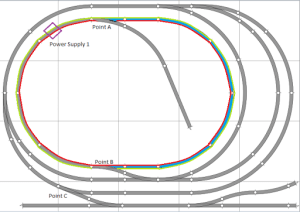
First an issue with Isolation. DCC layouts can support multiple trains on the same track due to given every loco a code and powering that code accordingly. With an analogue layout, you don’t have this luxury and 9 out of 10 times the golden rule is: one train per track/loop and one train per power supply
You can of course, like I have, design your layout to have multiple loops to accommodate additional trains which can be isolated from the power supply and swapped as desired. This works perfectly well for certain point setups…
When Point C and Point D are set in favour of the Outer Loop you are isolating the outside rail of the Inner (Orange) track. Locos must receive power on both rails to work, therefore by setting C and D in this way you have definitely broken part of the circuit on the Inner (Orange) loop and your train doesn’t move. Conversely you can set C and D in favour of the Inner (Orange) loop and this Isolates the Outer Loop allowing for aforementioned train swapage. Forgive me if this is simple stuff but it helps explain the next part a bit better. 
My plan was to deploy a similar tactic for the Blue section of track, isolating a train here allowing A and B to be set to allow access to the centre siding from the Outer Loops. This is essential for maximising stock on the layout. As the following diagram will illustrate this plan was slightly flawed… 
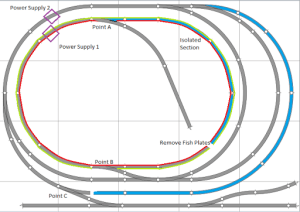
Even with points A and B set in this way the Blue section of track is not isolated. Wherever you place a locomotive on the oval it will still pick up power from ‘Power Supply 1.’ You can check this by choosing a point on the oval and see if the red and green lines end up at the purple box (Power Supply 1). And they always do.
We therefore need to create a break in either* the Red or Green line in the Blue section of track which we want to isolate.
*Remember we only need to break one rail for the locomotive not to be part of the circuit. 
Thankfully – this is painfully simple. 
Carefully lifting up the track I was able to remove both fishplate connections just to the right of ‘Point B.’
This achieves a physical break in the track. Don’t worry though, as long as you are accurate with your nailing (back) down the track is still aligned and this doesn’t affect the running of your trains when you DON’T want to isolate this section.
When you do however, you’ll notice that in the Blue section of track the Red line (rail) is now disconnected from Power Supply 1. 
You can now safely put a train in this section whilst you move another out of the centre siding. 
A similar tactic was also employed just to the right of Point C (above). 
Some modellers will add additional isolation points and purposefully reconnect them via an on/off switch. This gives them the option to turn power on and off to sections of continuous track should they so desire.
This is something for me to consider in the future, but currently it is not required on a layout of this size.
Getting Power To The Track:
The second thing I’ve done that relates to Powweerrrrr isn’t so much an issue but more of a way of making the layout look neater. It does also help in set up/down.
Here was what I was using before…
This is the ‘Hornby Power Clip.’ You plug in your power supply to the points A/B (above) and it slots into the side of your track. This is fine for those starting out, but I find them unsightly, unreliable and restrictive of at which spots on your track they can be slotted into. 
This is how they looked on my layout. I found that once you had a wire plugged into this one (above) on the inner loop, it was encroaching and restricting the loading gauge of trains on the outter loop. Securing the wire from not getting caught up in the trains on both loops was also becoming a problem.


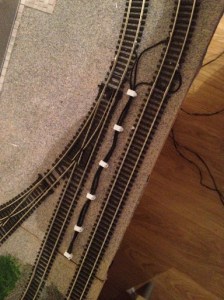
This (above) – killed two birds with one soldering iron. And some wire hooks.
Quite simply – I’ve soldered the wires straight onto the track. Then using wire hooks nailed the wire down to keep them away from trains. Eventually I will paint these black, and I think they will look like quite realistic lineside cabling! (Hopefully no OO scale people will come and steal it…).
I found it easiest to feed wires under track under fishplate joins. 
It may be worth removing a couple of the plastic sleepers where you intend to solder the wire to the track. I found it hard to avoid them melting…. The track is tough though and will accept the heat without buckling. Other modellers will solder the wire to a fishplate first, and then reconnect the fishplates to the track. This avoids being near any melting sleepers when soldering… But this sounded fiddley, so I didn’t bother. 
  
To complete the setup I ran the wires under the join and then along the side of the board. The controllers are then plugged in just out of sight on the right.
Next time I’m going to talk a little bit about adapting points to help reduce derailments. 

Side Tracked: Getting Ideas

Like me, you may well have a grand idea or vision of how you want your layout project to turn out. Even so, it’s a good idea to go and get some inspiration from other modellers and their layouts to see how they are doing things. After all, as we’ve seen so far, there are at least a handful of different methods for pretty much every aspect of your project. From scale to scenery from stock to track plans there’s such a sense of never ending possibility. This is good, mostly, but I find being inspired by one or two ideas gives a bit of focus.
Where can you be inspired?
Well taking a journey by train will certainly help, but I’m assuming at this point that you probably do this pretty frequently, or have done pretty frequently in your life. Needless to say if you’re modelling your layout on a modern era with modern stock, actually this is a very good idea. Secondly there are a range of publications and magazines to check out, and naturally lots of online content, you tube etc. But I don’t think you can quite beat going to an actual exhibition!
So I did just that at the Epping Railway Circle Exhibition in Theydon Bois this month. Why this one? Because I remember going to their exhibitions when I was young, and remember being impressed as a young boy with their layouts. That and it was near my house.
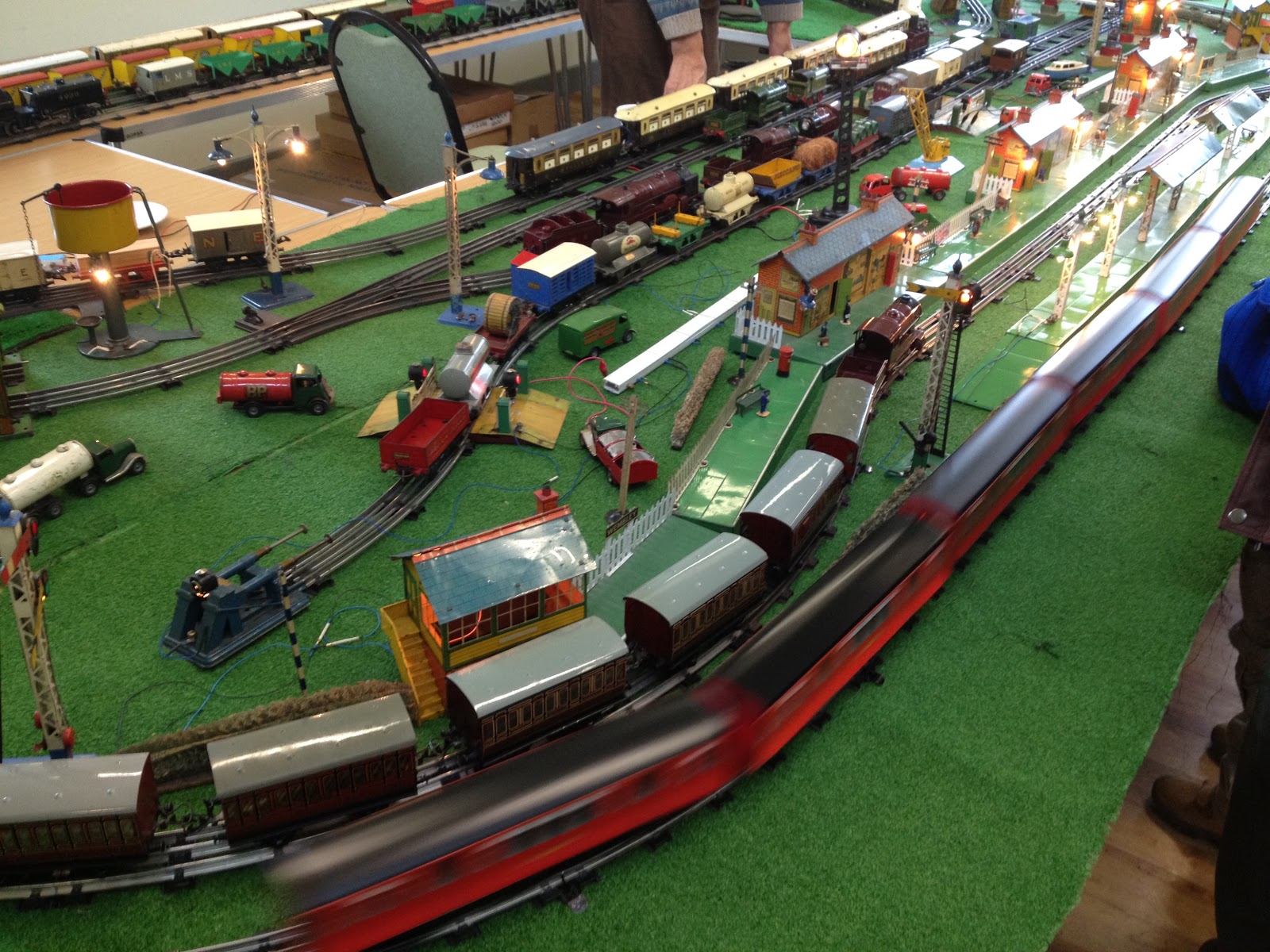
On display were 10 layouts which ranged in scale and theme. This is a pretty good reason to go to an exhibition, especially if you’re at the start of your modelling journey – it’s like an advertising exercise for all the different types of scales out there. The example above is a Vintage O Gauge (1:43.5) layout by Terry Isherwood and associates. It’s also a testament to the argument of not having to nail down your layout whilst still maintaining something that very much looks the part and good fun to operate.  Portable yes, but in the case of O Gauge you’ll need a fair amount of space for something on this scale. Another good reason for going to an exhibition is the sense of a local flavour. This manifests itself in the Epping Railway Circle with the inclusion of plenty of London Underground stock and themed layouts alike. As an R Stock train wizzes round at the bottom of the picture.
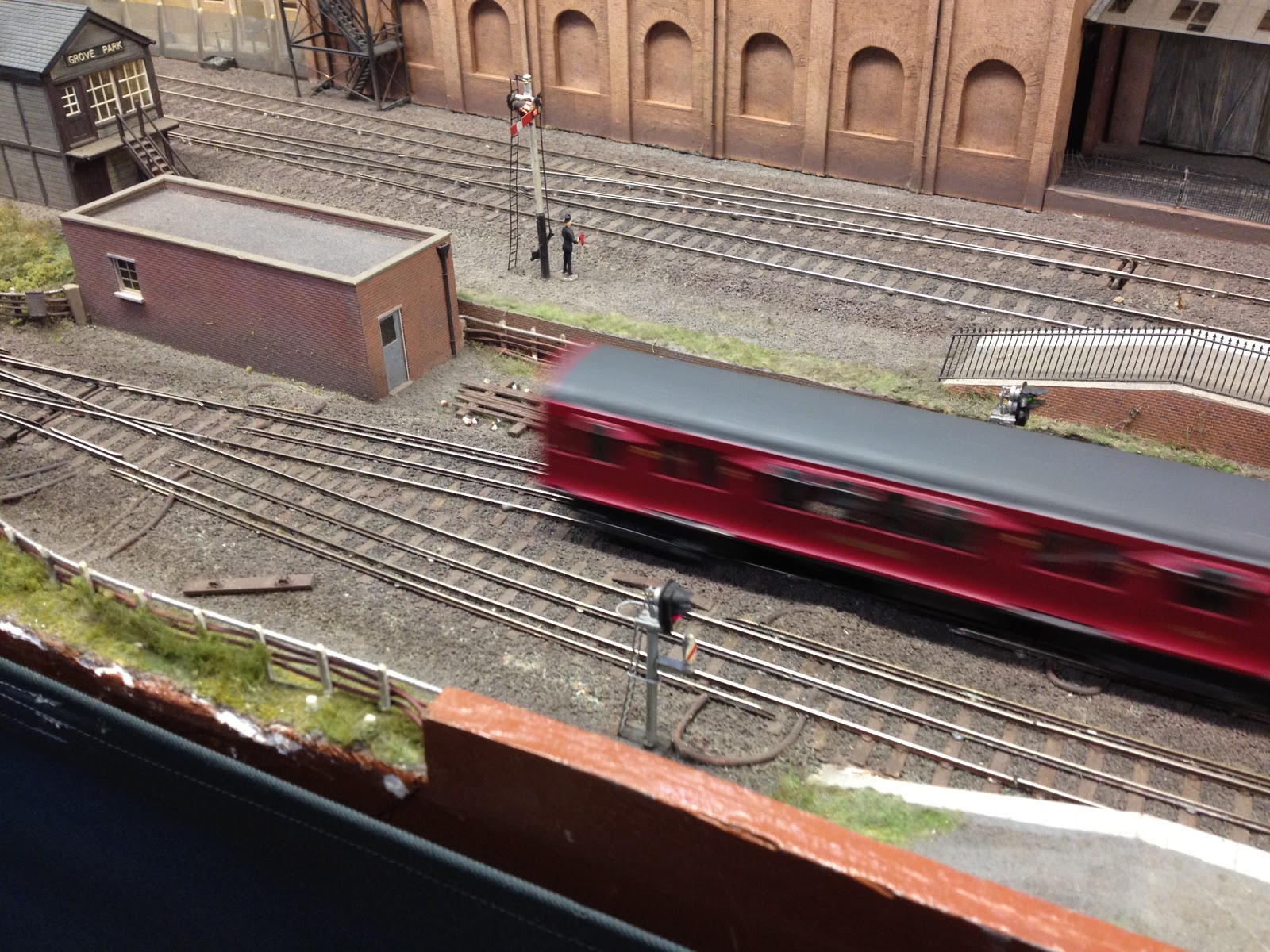
The same stock this time in EM gauge on the layout ‘Grove Park’ by Enfield MRC. Modelling the Underground gives the opportunity from some really interesting detail. 3rd and 4th rails and their power supply, line side cabling etc. All done impeccably well.
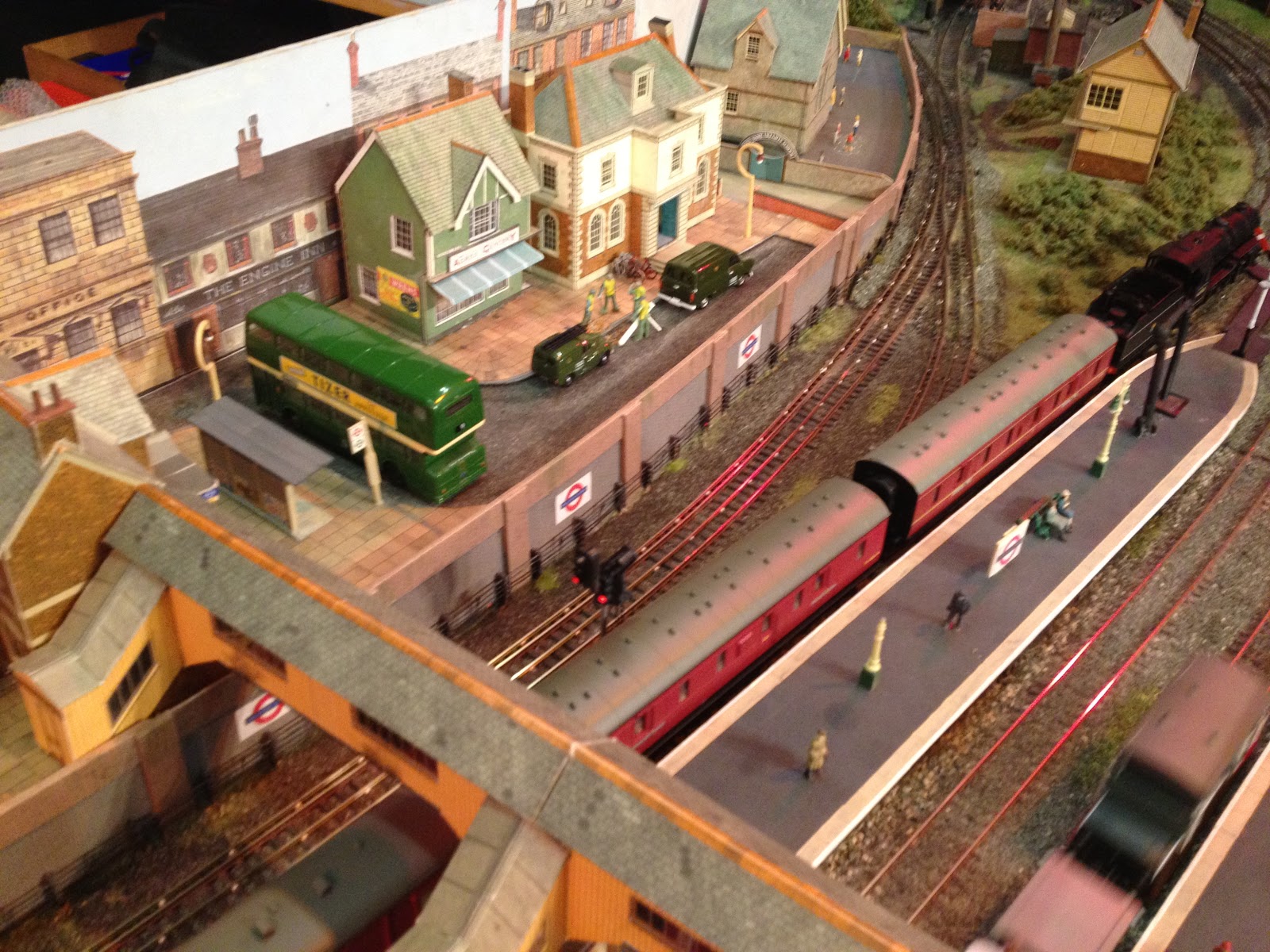
Another fine example being Tanglewood Common from the ERC themselves (This being their main layout). Set in a fictitious outer London suburb which probably has inspiration from real locations such as Epping, Amersham and Upminster where Underground lines used to (or still do) share tracks with national rail lines.
More shots of Tanglewood Common which also features rolling hills and fields as well as the main townscape.
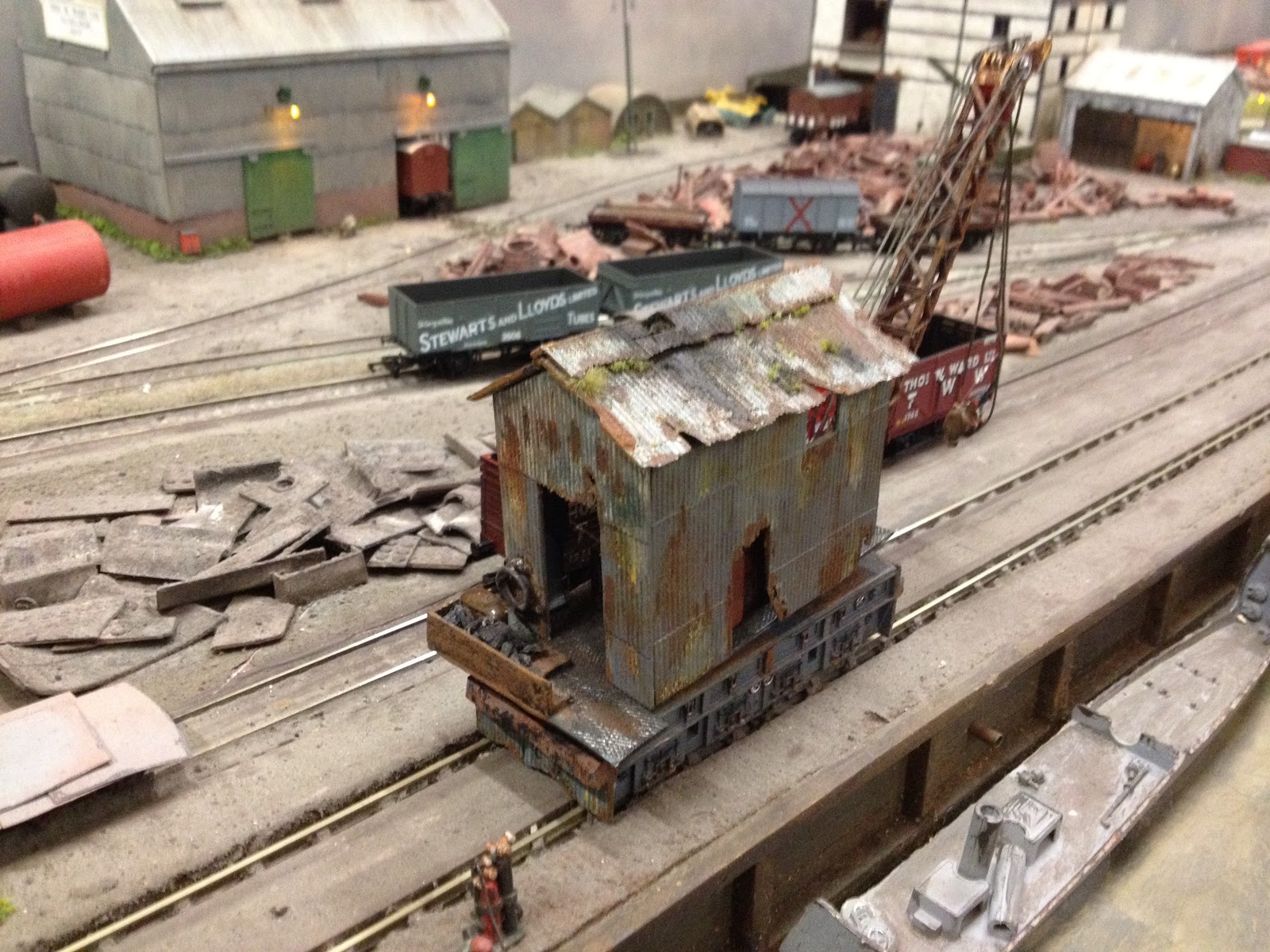
Not everyone goes for the countryside theme though. Columber Wharf an OO layout by Chelmsford MRC is a fantastic example of not only era specific but genre and theme specific with this model of a dock/scrap yard.
Some of the detail on this layout in particular was truly phenomenal including this excellently weathered and worn out looking shipping crane…
…this rather abandoned looking flatbed wagon…
…and some of the scrap itself. Flickering LED’s were used to mimic people welding or rather pulling apart scrap metal, which added a nice finishing touch.
A scrapyard scene perhaps not everyone’s vision, me included, but hats off to the level of modelling here. Look at it long enough and you might believe you’re actually there. Again this is an example if you want to do a ‘theme.’ A dockyard is pretty good idea as it gives for lots of scope of shunting and loaded wagons but another good concept is…
…the depot! Just as much scope for details and stock such as Slipe Lane from Peter Watson. The above two layouts open up the possibilities to something I’ve not really explored thus far and that is end-to-end layouts. With Tanglewood Common and my own layout (names on a postcard please) there is potential to leave trains running and to let the efforts of your modelling soak in. However with these end-to-end offerings you get the chance to really get stuck into the nature of an operational railway as you bring trains in and out of service and shunt stock into sidings. It’s also really very simple and effective. Everything is within arms reach (should you not have automated points yet, naturally this does), there’s not miles and miles of expensive track and you’ve created something that looks excellent in a very small space. It’s a concept I definitely want to explore in the future based on watching Slipe Lane.
Slipe Lane also offered up an insight into Digital Control. As aposed to analogue (which is what I have), simply a potentiometer connected to the track for ‘more and less’ voltage/speed and a switch to reverse the flow that’s pretty much all you get. With Digital (or DCC) you get far more scope for train control. You can have multiple trains on one line and program locomotives to start and stop automatically and accelerate or decelerate at pre-determined rates.  What’s more you can add sound and lighting to locos (some come with it pre-installed) and DCC can also control points, signals and even coupling from one control surface. Now this was my first time seeing a DCC layout with all these aspects featured. Previously I’ve been very sceptical about the need for model locos to have sound and all these fancy bells and whistles. I’ve always thought that a model steam train with synthetic ‘puffs’ and ‘hisses’ would just look and seem tacky. Well Slipe Lane gets the use spot on. Because the layout is themed on a Diesel depot the locos make (obviously) Diesel noises, engines firing up and revving into action, the sound of the horn and the sound of scraping wheels on curved track. This works in a way synthetic sound on steam trains doesn’t. The noise of a steam train is also associated with seeing…… steam! So for me when you don’t see any steam, the sound seems much more noticeably fake. With the Diesels, minus a bit of exhaust smoke, it’s believable that they’re actually making that noise. And this for me was brilliant.
On a lengthy discussion with one of the ERC members, I agree that if you’re going to do sound on your locos you have to do it properly and make sure all the locos have it. It doesn’t mean you shouldn’t opt for DCC though, it’s still incredibly powerful and I would definitely say that if you’re starting from scratch this is the future. For me, I’ve just got far too much of the old kit to get involved with it just yet. But good news, you can get decoders for existing stock. But that’s something for another day.
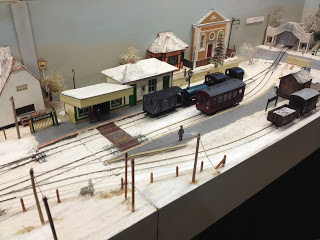
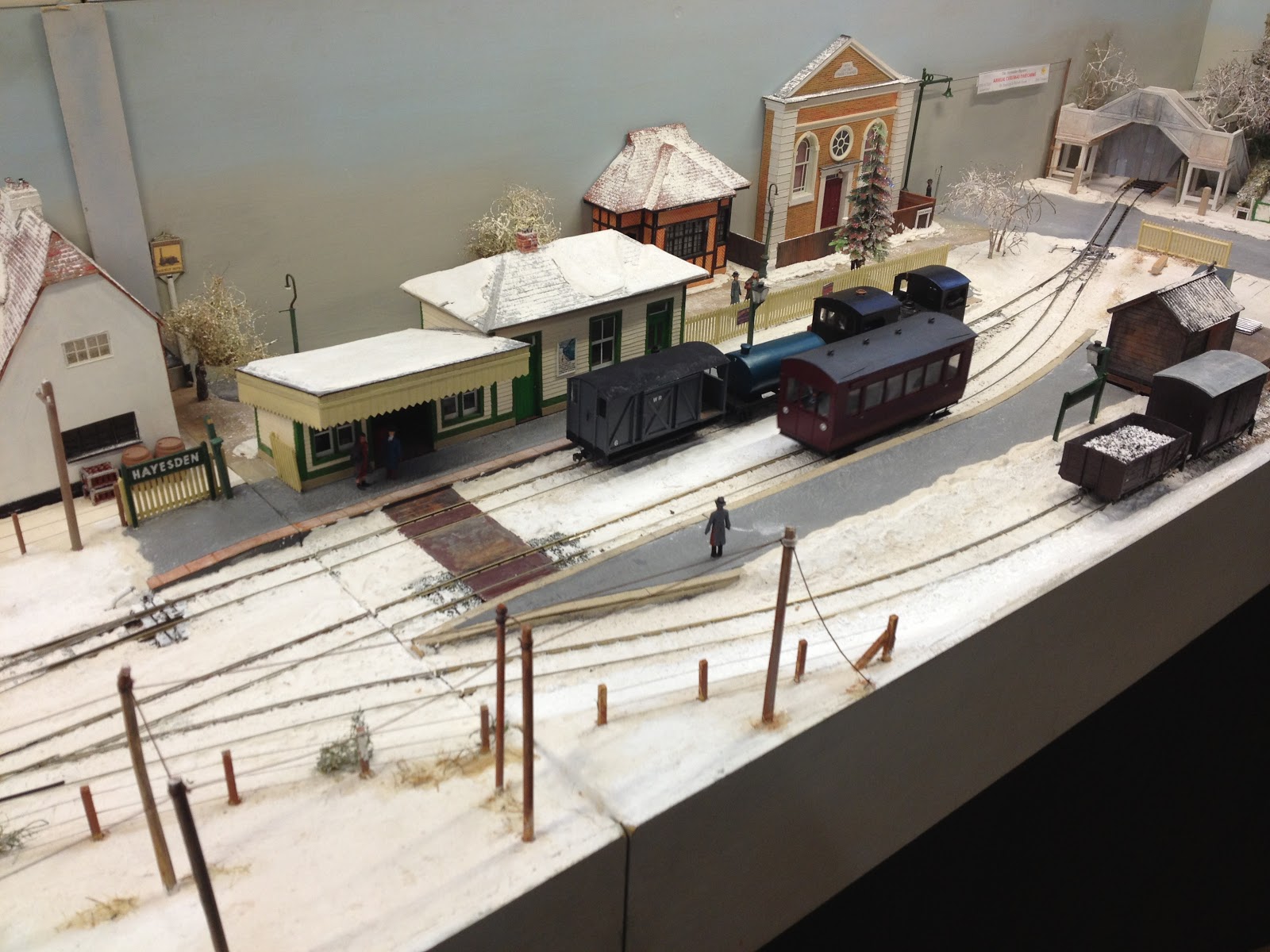
Here’s something slightly more alternative. Another end-to-end layout, but this time a narrow gauge line in O. This is Hayesden by Tony Martlock. I like the concept, scaling everything down from life size and then scaling it down again within the scale. Clever! I also like the wintery theme. Again, it breaks the mould from the usual countryside/town image. I imagine depicting a snow theme such as this is brilliant in the sense that everything has to be simply covered in white, be that scatter, paint or your medium of choice. But on the flip side… well everything has to be covered in white… you have to make sure your weather has happened uniformly after all! But I like that some of the wagons in the yard appear to have more snow in/on them – implying they’ve been lying around for longer than the main line stock adding realism.
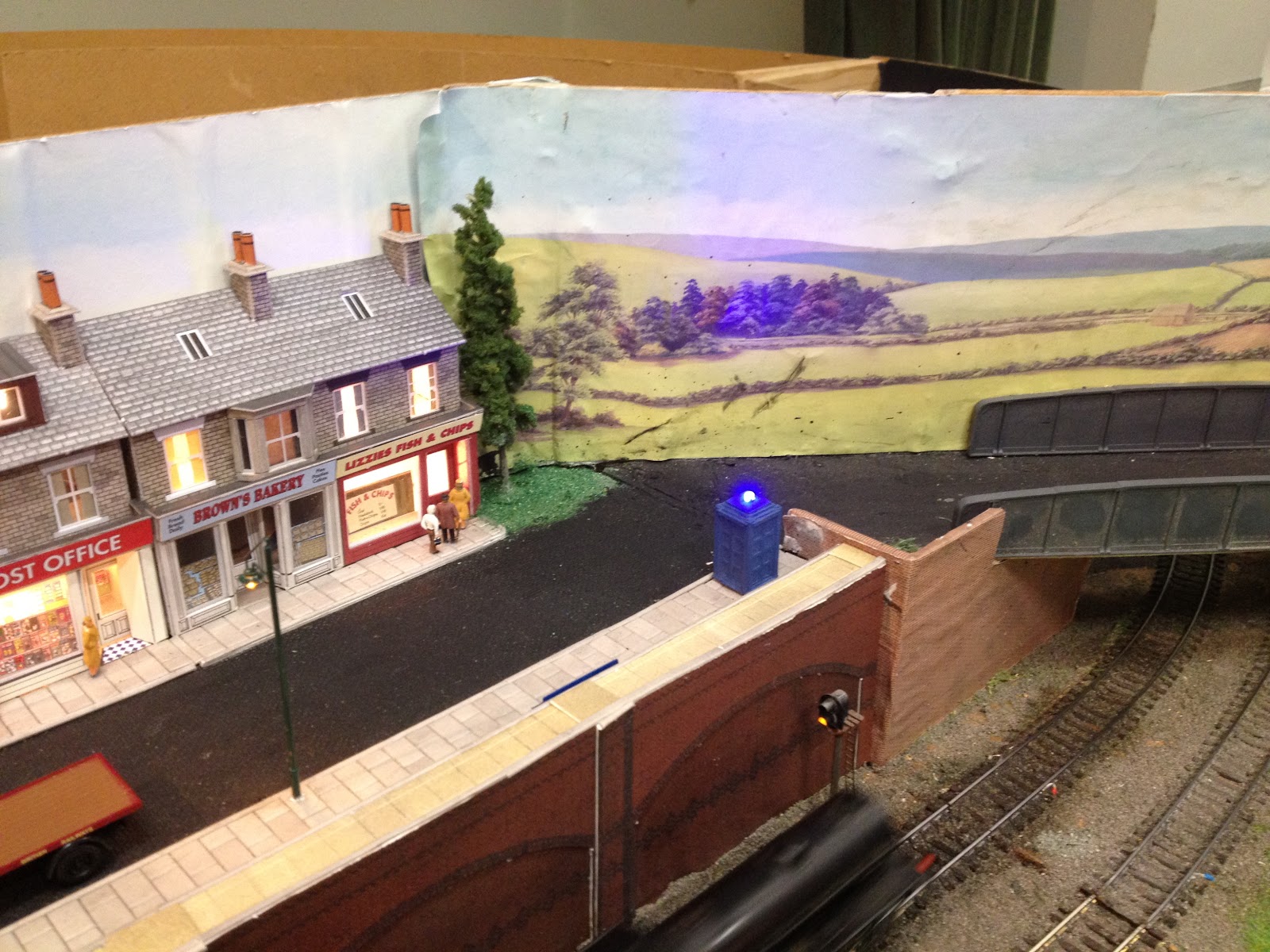
Finally I think modellers like a gimmick or two, or an easter egg if you will. This could just simply be a normal Police Call Box on the Redford by Mark Smith layout, but I definitely think it’s the tardis from the way the light was going on and off….
It might be easy to become disheartened at an exhibition of this calibre, but remember these layouts have been years in the making with some seasoned people at the helm. I was offered some good advice by one of the ERC members… ‘Model for you.’
It’s your layout after all so run what you want, it doesn’t have to be a theme or an era but hey! If dockyards or the Underground is your thing then why the hell not?! Model to a level you’re comfortable with and build on it. You can achieve some great results by not overly complicating things as seen above and like me an exhibition will definitely give inspiration into this.

Toop Tramway by Crodyon MR and Maiden Lane by Pater Watson.