For a brief spell in the 1990’s the Watford DC Line was operating under the moniker “The Harlquin Line.” Details as to how this came about have been lost in the mists of time, but a few forums suggest the title was acquired from a public naming competition ran by Network SouthEast.
Some say that Harlequin is a portmanteau of HARLsden and QUEENs Park. Others have suggested that the inclusion of Harlesden is merely a happy coincidence and the name is actually a triple portmanteau of HARrow, WilLESden and QUEENs Park.
At some point, perhaps after privitisation, the Harlequin name seems to have dropped out of use in favour for the less interesting “Watford DC Line.” Either way if you’ve got any information about how this brief but quirky name came about, do drop a comment below…
Image copyright A Carter – CallingAllStations.co.uk
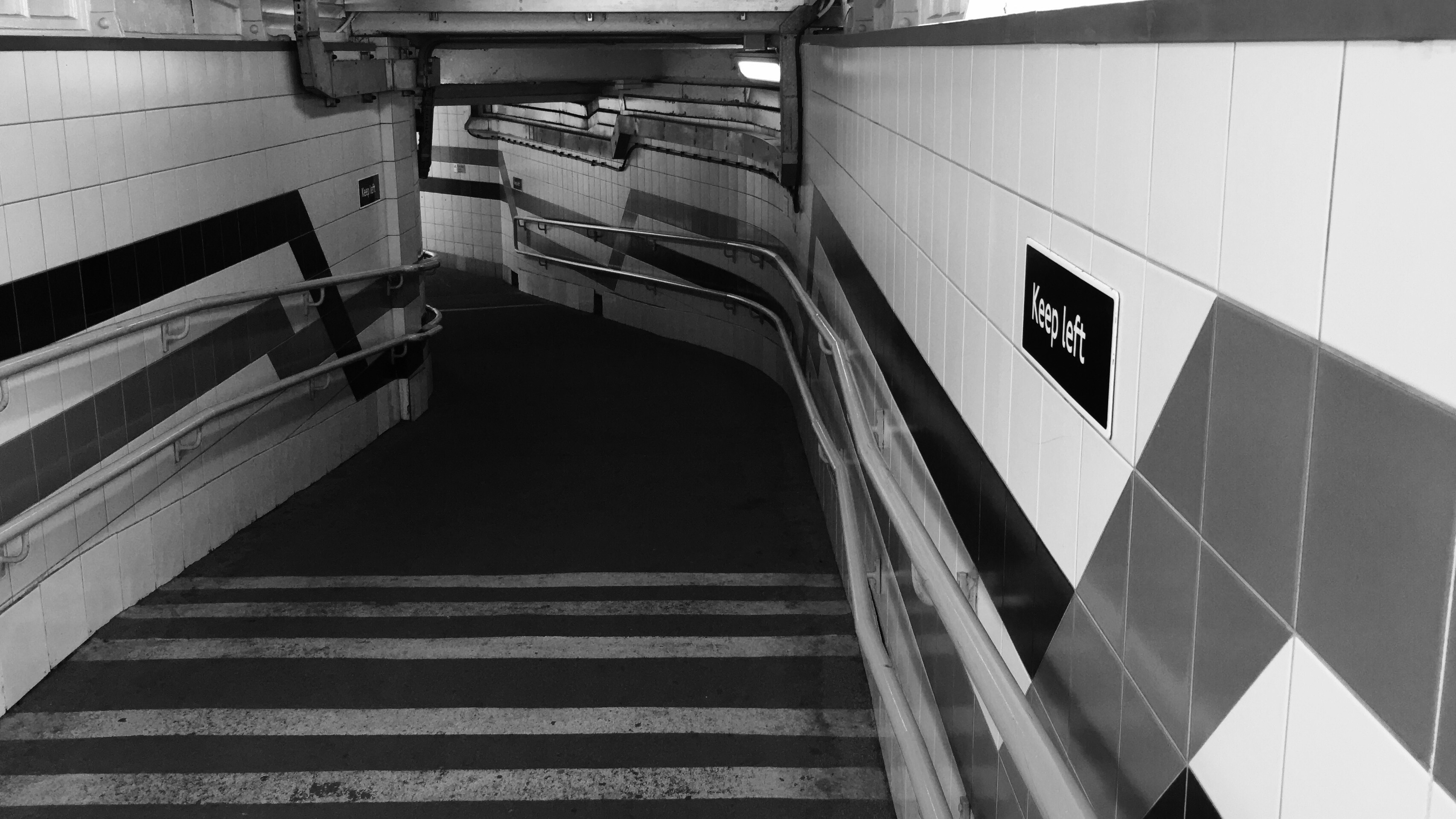
Willesden Junction shouldn’t be that confusing. It has 5 platforms. 2 up top for the Overground, 2 down below for the Bakerloo and Watford DC lines and a 5th lesser used bay that we don’t really need to worry about. The thing is, it’s not Willesden’s platform layout that we found confusing, it’s the connecting passageways and non-descript exits that really will disorient and bemuse you.
I suspect it’s down to the history of Willesden Junction. This used to be 3 technically separate stations (the two we’ve mentioned already plus a now demolished main line station), each built stand alone with their own unique entrances. Sure they’ve been knitted together after, but the entrances have not been sufficiently rationalised. This probably wasn’t too much of a problem until very recently when the advent of the automated ticket barrier meant you couldn’t simply walk back through the station if you got it wrong. Now, exit at the wrong gateline and, due to the nature of the railway landscape, you’re about half a mile away from where you actually wanted to be.
The signage doesn’t help either, especially for new comers not really sure of their surroundings. Victoria and I learnt this the hard way when we both agreed to follow signs for “Buses” blissfully unaware there were in fact “Buses” at both exits…
Image copyright A Carter – CallingAllStations.co.uk
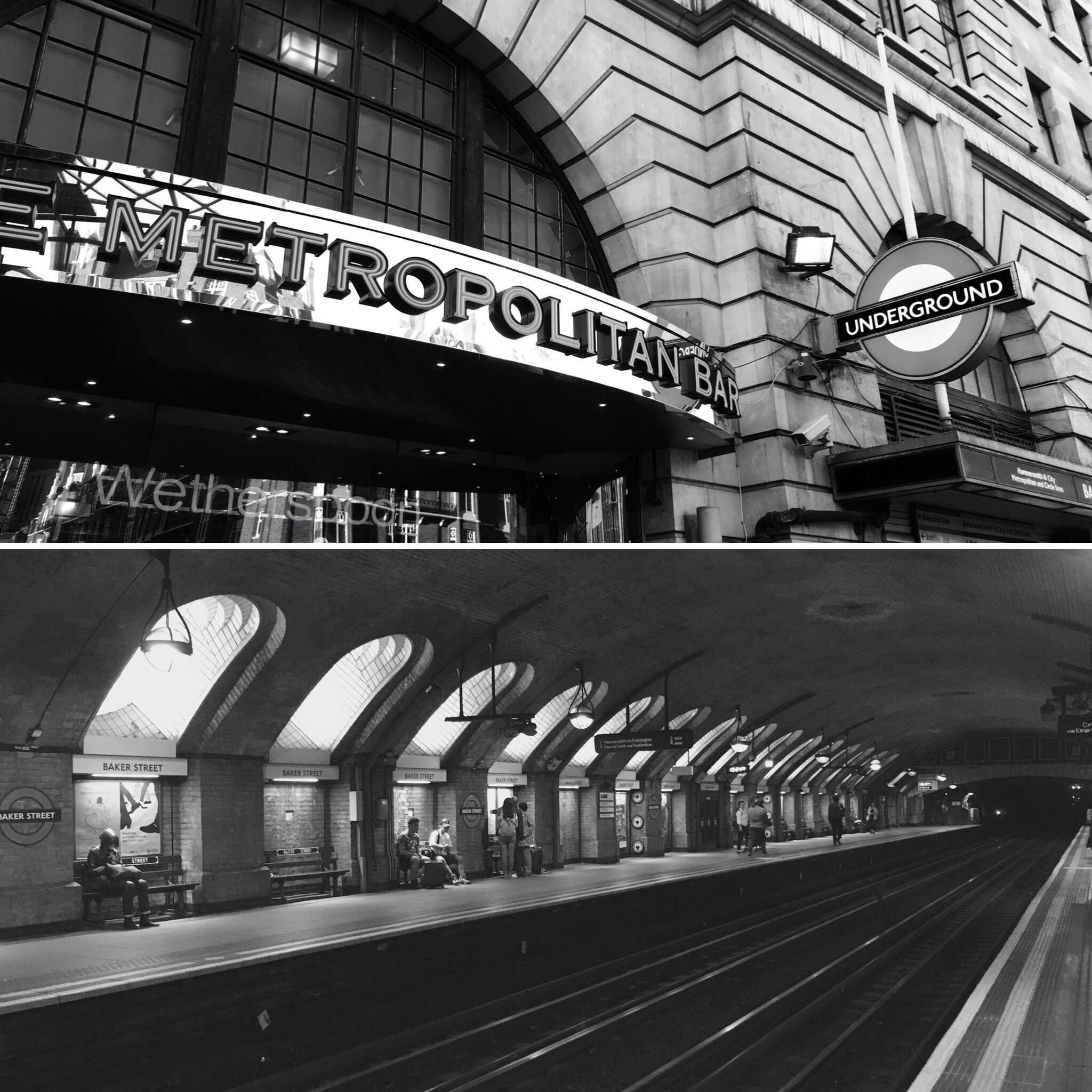
One of the first underground stations to be built, Baker Street is certainly steeped in history. The world’s first underground railway was powered by steam and it’s almost difficult to imagine that this clean well-kept station once hosting loud and billowing steam locomotives. Anyone who’s ever ridden behind a steam loco going through a tunnel will tell you how quickly these cramped spaces fill with sooty smoke. However even in the 1860’s, our Victorian cousins were thinking about how to mitigate the use of steam power in such confined conditions. Compressors were used on the locomotives to help reduce the amount of exhaust smoke and special considerations were given to the designs of the stations and infrastructure. The construction of the arched retaining walls here at Baker Street on the original platforms (now served by Circle and Hammersmith and City Lines) were famously designed to let daylight in and steam and smoke out.
Upstairs is one of my favourite features of any Underground station – Chiltern Court, the grand Edwardian era Charles Clark building which housed the Metropolitan Railway’s headquarters, luxury accommodation and a hotel. This is not a feature unique to the Metropolitan Railway and, as we know, some of London’s top architectural delights are former multipurpose railway headquarters. Facilities like those here at Baker Street and others at St. Pancras and Marylebone, were built to not only welcome the railways’ passengers but to provide a showcase for the company’s might and wealth.
Part of Chiltern Court is open to the public in the form of The Metropolitan Whetherspoons which is certainly well worth a visit.
Image copyright A Carter – CallingAllStations.co.uk
As you may know we visited Downham Market this week to take a look at the fantastic NSE style refurbishment. This will form the basis for a follow up video to “In Search Of Network SouthEast,” which I intend to get edited in the next 2-3 weeks. In the meantime check out the Periscope we did from Downham Market below…
Don’t forget to keep sending in your pictures of NSE signage and infrastructure to @CASRailwayBlog and I’ll feature them in the video!
Last year I went on a tour of the abandoned parts of Euston station. You might have seen the video. These are naturally excellent content producing opportunities as the subject matter is always bound to draw viewers and readers into Calling All Stations. Sure, visiting these abandoned spaces is nothing that hasn’t already been done on blogs and YouTube, but I always feel duty bound to provide my subscribers with my accounts and experiences of the visits. Abandoned stations tend to be very photogenic so there’s also plenty to snap.
Except this isn’t always easy. The juggling act of getting great shots that I can work with afterwards whilst still listening and paying attention to the LTM guides (of whom you’ve paid good money to follow round) is somewhat of a challenge. This is made even harder if you’re trying to shoot video, especially if you’re trying to frame out the rest of the tour group – who are also trying to get that perfect abandoned-look shot! There’s certainly a sense that the tour guides want to move at a fairly swift pace as well, and I’m reluctant to hold up the group or miss out on any juicy facts just because I’m at the back taking a picture of that empty tunnel behind us. I’m not sure if this was always the case, I remember a tour of Aldwych around 4 years ago where the guides allowed more time for people to get ‘that shot’ of the empty platforms that they so craved. Perhaps LTM are trying to pack more tours into a day, or maybe the Aldwych tour is at a more relaxed pace, but I’ve come to realise it is what it is and I’ve got to work with the time I’m given.
With all this in mind I figured that perhaps a different stance was needed on the visit to the deep level shelters at Clapham South. Instead of producing a narrated video like the one at Euston, I decided to make a return to shooting higher-quality stills and using these to develop a more artistic approach. Whilst I realise applying Instagram filters to plates of chips is somewhat of a cliché, I am however all in favour of doctoring images in post to enhance the viewing experience in a more creative setting. What I mean by this is in reality the shelter was well-lit and full of the people on the tour group, whilst what I wanted to create was the sense of a gloomy, decaying, empty and desolate place. This is naturally not something I normally get to do for my documentary videos.
Now creating spooky images is simple enough, but a silent slide show of the collection would be… well a bit boring really. What they really need is some suitable music to go with them. So it is with great pleasure that I get to collaborate with friend and colleague Robin The Fog, a leading Musique Concréte artist, in creating a the full audio-visual experience that a space like Clapham deserves.
Robin creates his music, not by fancy digital means, but by using tape loops. Taking any old sound as mundane as a squeaking gate or slamming door, Robin loops these sounds through tape recorders and varies the speed in which they play back. The process is then repeated and layered with delayed loops running at different speeds until the sound is unrecognisable from the original recording. The effect is a rich and colourful yet slightly chaotic sonic masterpiece that will likely amaze and terrify you at the same time. Think 1970’s sci-fi film score meets Radiophonic Workshop.
Writer Leila Peacock explains a little more about how the sounds you’re about to hear were created,
The ruins of the Spanish House stand on the banks of the river Sava at the heart of the Savamala district of Belgrade. Originally a decadent customs house in the heart of a bustling port, this decaying structure bears the imprint of many generations. Now an empty echo chamber, its walls reverberate with the rumble of the passing freight trains like the sea inside a shell; songs and shouts return distorted from a trip around the flooded basement and exposed structural supports become an unholy set of chimes. All the sounds you hear on this track were recorded on site and nothing has been added that is not of the building itself. This echoic palimpsest is architectural portraiture in sound.
The track used in the video is called ‘Savamalan Rust, Parts 2 & 3,‘ and is a previously unheard outtake from ‘Secret Songs Of Savamala‘ the 2nd album roduced and released by Robin’s band, Howlround. The sounds you hear are exposed metal structural supports recorded in the flooded basement of an abandoned customs from that Serbian subterranean world. A very fitting marriage, I hope you’ll agree, to the imagery of Clapham South shelter.
To hear more of Robin and Howlround’s work head over to their website.
Clapham South Shelter was opened to the public in 1944 and offered shelter to some 8000 people during wartime London. After the war the shelter was repurposed and has seen action as a temporary hostel, a hotel and a government archive store. London Transport Museum now offer annual tours of the mile long complex of subterranean passageways and bunkers.

 Calling All Stations