Tube Suffers 16 Days Worth Of “Staff Shortage” Closures In 2016

You know the drill, you’re scrolling through Twitter and you might spot something like this…

https://twitter.com/centralline/status/831639543518486528

Now is it just me, or does this seem to be occurring more and more often?

Well it turns out it wasn’t just me, but Diamond Geezer too – who back in January had certainly clocked on to a spate of early and late night closures on the District Line. This got me thinking… How often did “staff shortages” result in station closures last year?

So I put in a FOI request to find out.

It turns out it’s happened quite a lot: over 24,000 minutes worth. That boils down to the rather delicious “Evening Standard Style” headline of around 16 days worth of closures in total. Staff absences can happen for a number of reasons in any job, we all know this. Unexpected sickness, late running taxis, adverse weather etc. But are any particular stations bad offenders? What line suffers the most closures? And, what I really want to know, is there a correlation between station closures and TfL’s “Fit For Future” staff restructuring scheme?

I’ll hand over to Diamond Geezer’s follow up post where he breaks down the numbers, figures, lines and stations and tries to make sense of it all… Well worth a read!

Almost half the District line’s total is explained by Temple, and two thirds of the Circle’s. Meanwhile Holland Park and Queensway contributed over 60% of the Central line’s appalling-looking total. The surprise might be the Victoria line, which managed to have staff-related closures at 14 of its 16 stations. At the other end of the table obviously the Waterloo & City line had the least disruption, but the Metropolitan was next with only 369 minutes, because most of it is above ground.

Take all of this with a pinch of salt, because you can prove anything with statistics, and 2016 was a wholly atypical year. But what’s for sure is that December saw an unholy station-staffing debacle on the Underground, with 150 station closures in just one month. The RMT’s overtime ban was the trigger, suggesting it was only overtime holding TfL’s staffing reorganisation together, and this all too easily fell apart.

Continue Reading >>

Source: diamond geezer

055/270: #Paddington (District, Circle & Bakerloo) – The Error

It’s 07:30 on Saturday morning and I’m getting out of the city for the weekend. I’m at Paddington which didn’t disappoint for photo opportunities as I instantly found the shot I wanted: The roundel with the impressive Brunel roof of the mainline station in the background.

However, take a look closer… yes, go on, closer still… Something is wrong. Very wrong.

It wouldn’t be the first time incorrect fonts have appeared on the Underground, and at first glance you might struggle to notice the difference. Even I might have passed this by had I not been encouraged to take a closer look at an image taken by Tim Dunn of the same sign, coincidentally later that same day.

After further investigation, I think the font on the roundel is called Calibri, though some have suggested it could also be Verdana. (See if you can spot it, it’s all in the E. Type it out in word if you don’t believe me!). Quite why Calibri has been used instead of the ubiquitous New Johnston I have no idea. It’s possible TfL isn’t actually responsible for this stairwell and it’s signage and perhaps it’s instead managed by Network Rail. Someone will probably be able to tell me if this theory has any legs because it’s equally plausible that someone at TfL has cocked up – Calibri just happens to be the default font in Microsoft Word at the moment… Just Saying…

Either way, it’s given me an easy name for the blog post – so it’s all panned out great in my eyes…

Image copyright A Carter – CallingAllStations.co.uk

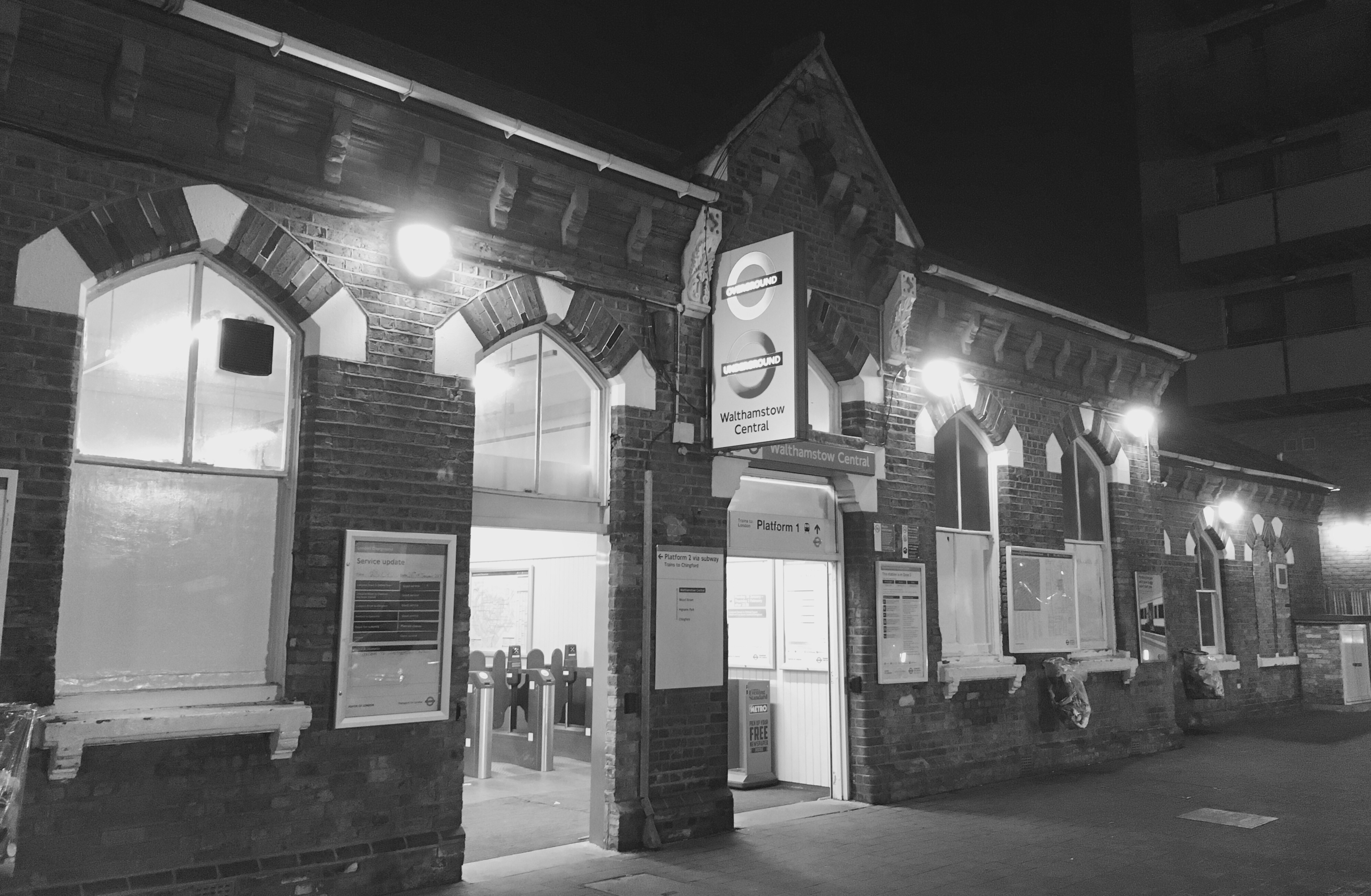
054/270: #WalthamstowCentral – The Backup

Walthamstow Central is one of my backup stations. When the Central Line is broken, this or Blackhorse Road (014) is where I’ll be headed. We’re 27 days into the year and I’ve used both…

A station existed here for nearly 100 years before the Victoria Line showed up. If the signs didn’t tell you where it was, you’d be forgiven for completely missing the ticket hall which hides beneath the Overground tracks to Chingford.

Long before the concept of Zone 3 existed, this area would have once been surrounded by fields and open countryside. It’s a far cry from the shiny new flats and developments that now surround and dwarf the quaint Victorian era station building.

Image copyright A Carter – CallingAllStations.co.uk