S Stock By Bachmann

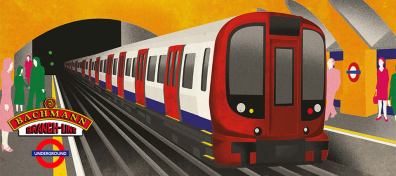
Needless to say I’m super excited by the announcement of a factory motorised S-Stock set from Bachmann. So much so that this info couldn’t wait for the Weekly to feature on CAS, so here comes it’s own article…

Image From LT Museum Shop

Although 1:76 models of tube trains have been available for a number of years from other manufacturers (notably EFE), none have come pre-fitted with motors. Bachmann will offer a starter 4-car train pack which will set you back £280 or the full 8-car formation for a whopping £439. They’ll also offer a number of intermediate cars for £39.99 each so you can make up S7 and S8 formations from a starter 4-car pack in your own time…

“Why has the Museum commissioned this model?

London Transport Museum is a Registered Charity and all the money raised from the sale of these models (and all other Museum commercial activities) helps to preserve, exhibit and promote our world class collection and support our charitable activities.”

Those might be eye watering prices, and whilst I’m sure Bachmann are going to take a cut, at least your money is in part going to the good cause of railway preservation. It’s also worth considering that the prices are comparable to what you might pay to make up a full HST-set.

There’s nothing in either the Bachmann or LT Musuem press releases to suggest these sets will be limited but they will only be sold exclusively through the Museum Shop so expect them to be popular, with potential to sell out quickly!

Pre Orders are currently being taken and the models will be available from the Museum Shop in early October.

Read the full press release here: S Stock Model Underground Train | London Transport Museum Shop.

– Andy Carter

A60 Home Improvements

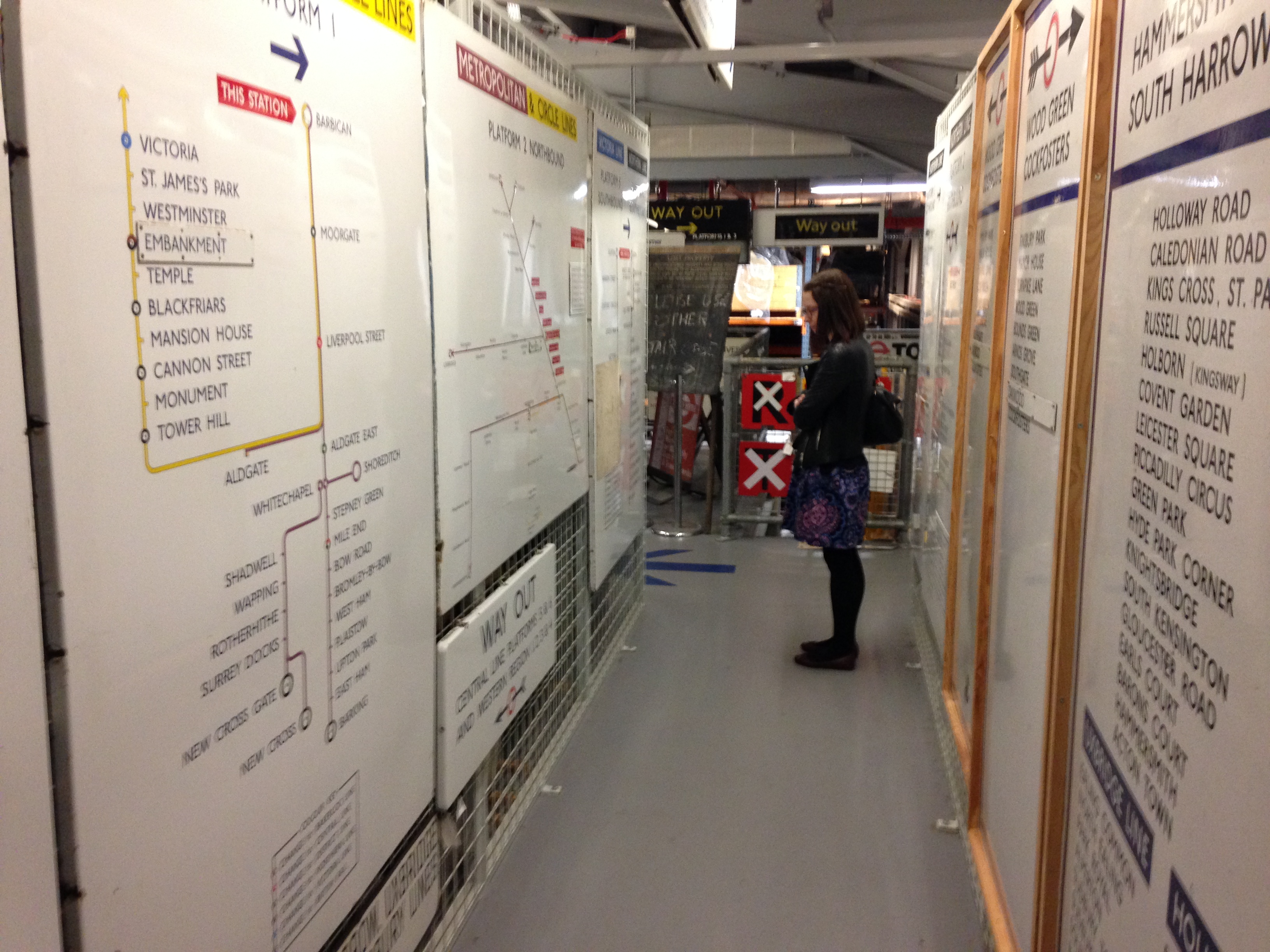
Last weekend I found myself down at the TfL Museum Depot Open Day at Acton Town. This is, for those not in the know, the ‘store cupboard’ for everything TfL doesn’t have on display at their flagship museum outlet in Covent Garden. It houses everything from rolling stock to enamel signs, from signals to station plans. One day it’ll be worthy of it’s own post but needless to say it’s a treasure trove for transport geeks like me, and it’s full of all manner of odds, ends, tidbits, miscellany and whatnot.

IMG_4825

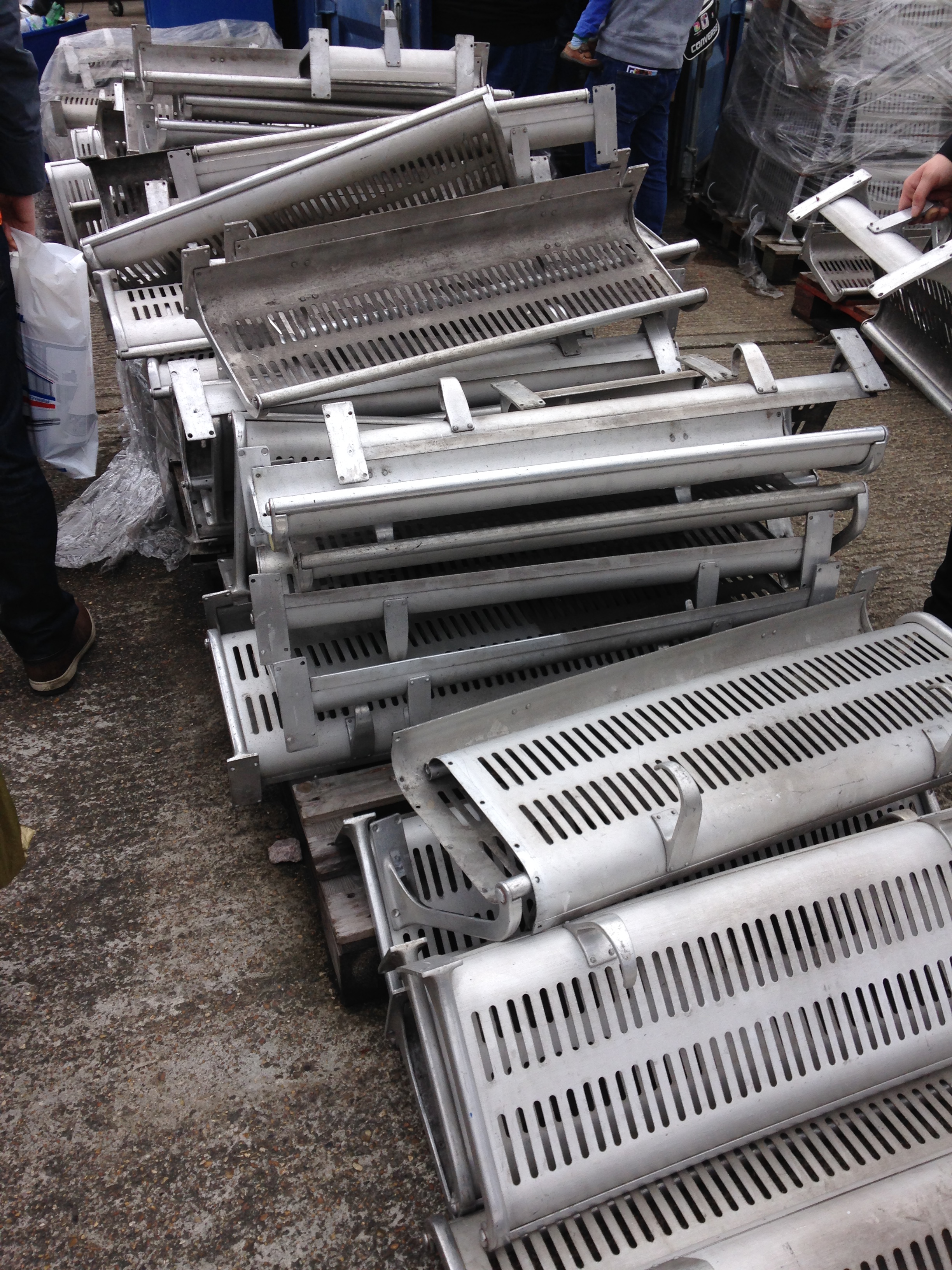
With each passing year, obviously wising up to the popularity of these events, TfL haul over more and more of the stock on offer at the Covent Garden/Online shop and it’s a good time to pick up a bargain. It’s also one of the few instances you’ll be able to get your hand on something a bit more special on the cheap! They’ve always had a few bits of paraphernalia on offer, mainly old enamel signs (at very reasonable prices by the way) but something more intriguing had caught my eye…

IMG_4830

This pile of rubble may look like scrap metal to the untrained eye, but even most Londoner’s will be able to tell you these are luggage racks. Luggage racks that used to belong in one of these…

A60-imageby_Oxyman2

A-Stock (mage by Oxyman)

An A60/62 stock train that for 50 years slaved away on the Metropolitan Line. In fact here’s how those luggage racks would have once looked…

A60-imageby_Oxyman

A60 interior (Image by Oxyman)

They were one of the few, if not the only (and certainly the last), tube stock to be fitted with luggage racks*.

TfL had already worked out it could cash in on the decommissioning of old stock, and these luggage racks have been on sale through their website and in the Covent Garden shop for the best part of two years. As you’ll see though, the asking price for even the small ones (pictured centre right) is not to be taken lightly! They also would pre-clean and spray paint them for you in a tube line colour of your choosing if you want to pay north of £100. Despite the price, I always had my eye on one but never got round to taking the hit. Eventually the supply of luggage racks from dismantled A60’s ran dry before I could snap one up.

Until I stumble upon that pile of metal at the Open Day! More exciting still, they were being sold off far lower than their original asking price! I picked up one of the small luggage racks for just 30 quid. They were also selling painted versions for £75, but couldn’t quite justify the extra expense when I could probably improve it’s fortunes on my own.

IMG_4832

Now, I don’t know if the racks they sold ‘RAW’ through the website would have came this grubby… But you’d be forgiven for thinking the one I picked out (above) had still been in use and unscrewed just yesterday! In fact it was actually one of the cleaner, less dented specimens on offer!

IMG_4833

I thought I’d need some industrial strength cleaner, but this is how the rack looked after washing up liquid, hot water and elbow grease. I then went onto use a spot of Ciff between the joins to remove any stubborn bits of muck.

Having seen how good they looked sprayed, I’ve decided to go ahead and paint mine myself.

IMG_4837

This is how it looked after one coat of grey primer. Already looking smarter!

IMG_4840

…and after the 2nd.

IMG_4841

…Although the light doesn’t show it well, this is after the 1st top coat of Gloss White.

IMG_4843

Incidentally if this occurs during any spraying work you’re doing, like it did for me, it’s due to particles of silicon getting stuck on the surface which the paint then refuses to adhere to no matter how much you apply.

IMG_4844

I used watered down paint thinners to lightly strip back the offending areas (above). I’m told Lighter Fluid or Vodka will also do the trick.  Be careful not to be too vigorous in your rubbing, you don’t want to take off the primer coat. Use a tissue rather than a a fabric cloth for best results.

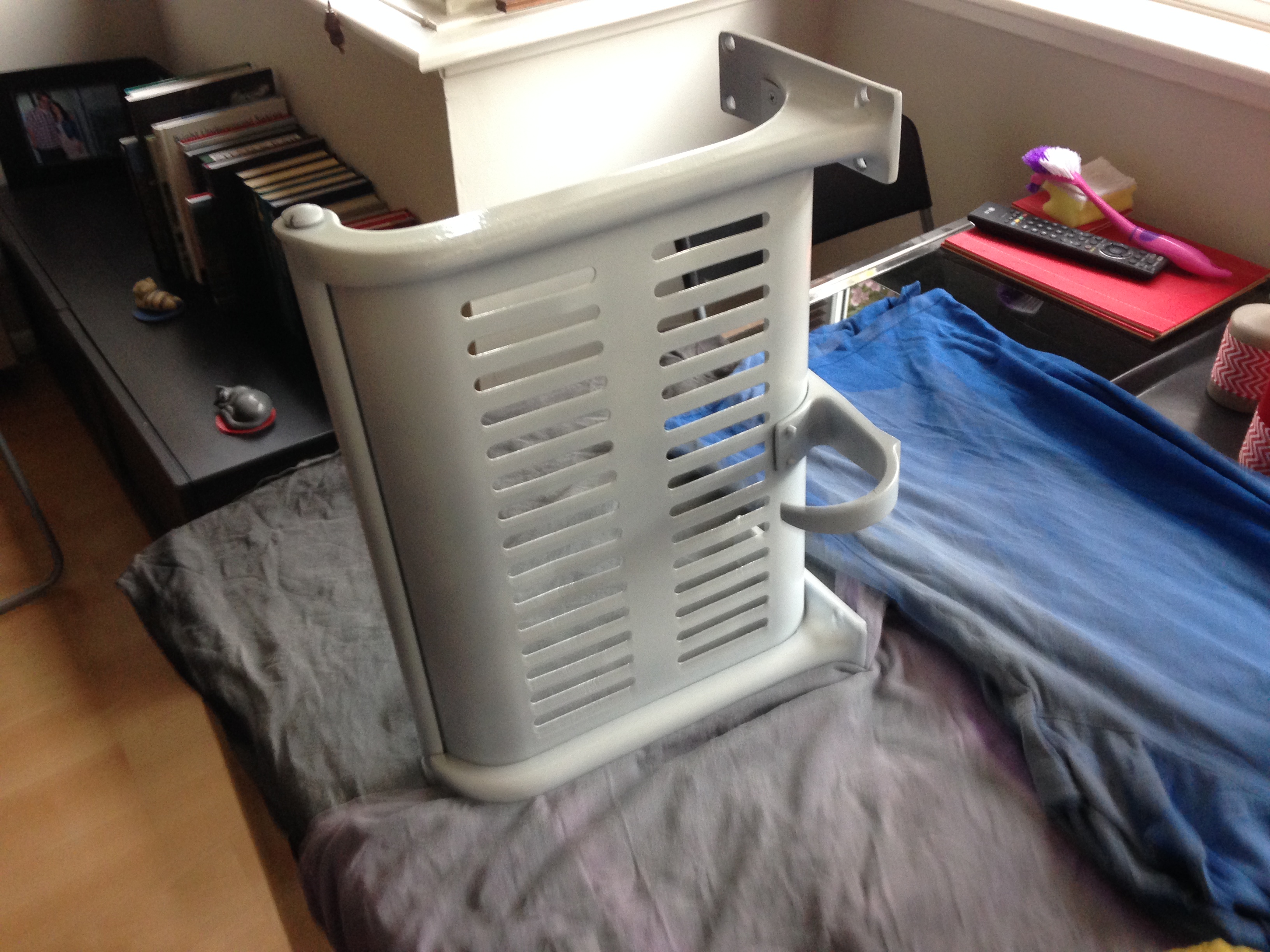
Much better! Now time to attach to the wall!

I must say I’m rather pleased! It’s certainly useful for hanging jackets and holding suitcase-looking microphone boxes…

IMG_4854

*This is down to the fact the Metropolitan Line (in it’s form since when the stock was introduced in 1960) predominantly caters for long-distance suburban commuters. Unlike other lines it was assumed passengers would be on the train for a long period of time, so they were kitted out more akin to mainline coaches – hence the luggage racks. This also explained the rather generously comfortable seating arrangement, when such a thing was still acknowledged as a priority over capacity!

-Andy Carter

How Many Pringles Can You Fit In Crossrail?

It’s nearly midnight on a Tuesday evening and after an unusual set of events I find myself calculating how many Pringles you could fit into Crossrail.

IMG_4541

Let me fill you in on the background story…

IMG_4544

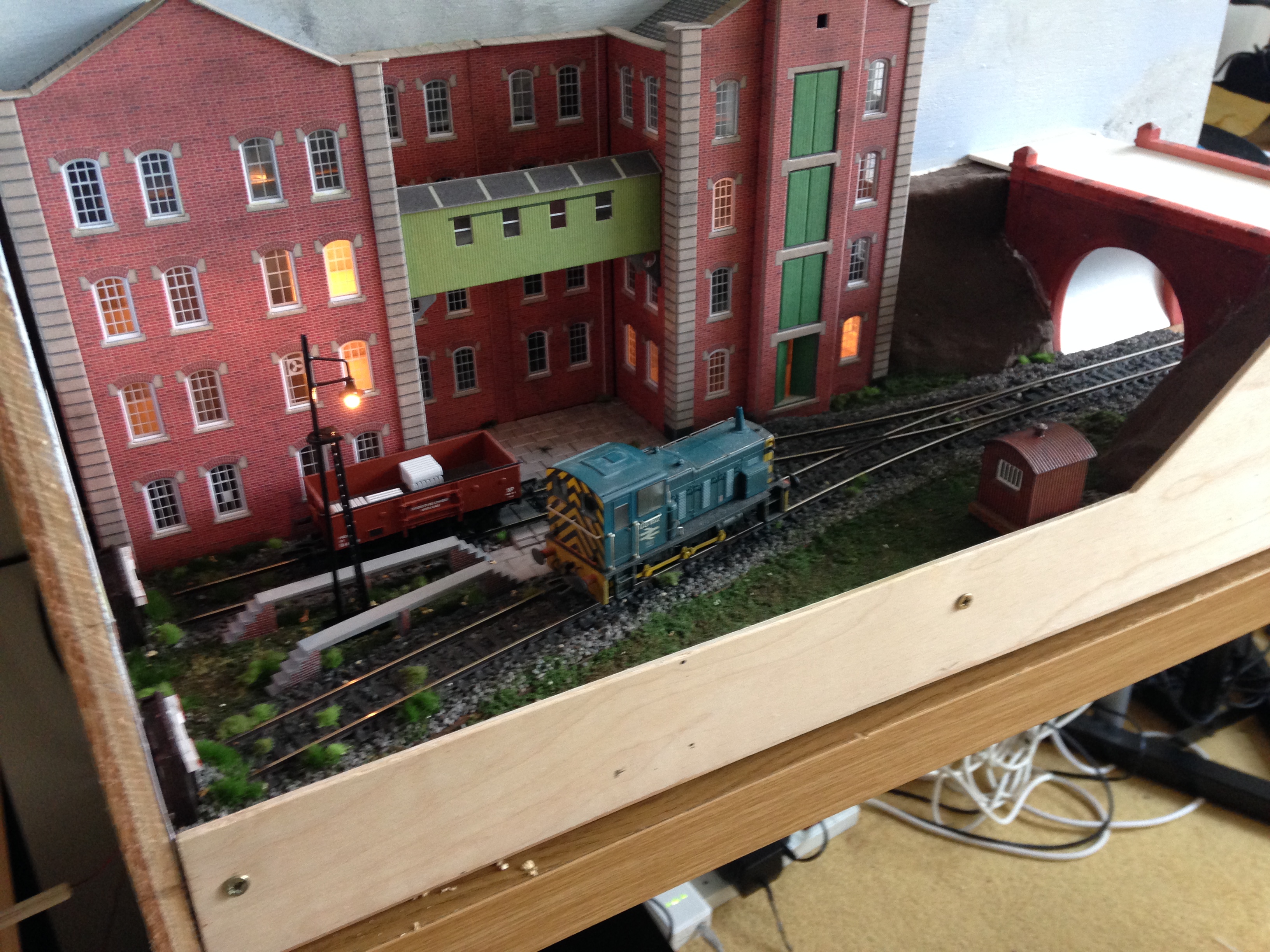
Recently I’ve been working on a new micro-layout project. A proper blog about it will come soon, but all you need to worry about right now is the bridge/tunnel shown in the picture above.
IMG_4538

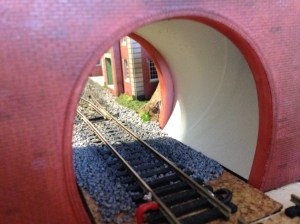
I discovered that a cut up Pringles can provided the perfect tunnel wall shape for the bridge.

Nothing unusual yet, just a bit of creative problem solving from a modeller… But being the funny b*stard that I am, I posted the following tweet:

https://twitter.com/AndyPCarter/status/577513401599057920

This proved to be very popular, and whilst I wouldn’t say it went ‘viral’ by any means, a combination of 28 retweets and favourites is probably something of a personal best.

It even prompted a couple of comments, the most intriguing of which was from Harold from @MODRATEC – a small model railway company operating out of Brisbane in Australia. He said:

https://twitter.com/modratec/status/577932629367877632

Crossrail promises to be, my condescending jibes aside, one of the most advanced tunnelling projects the world has ever seen. Many trials, challenges and tribulations will be asked and solved by it’s 10,000 strong work force. But I seriously doubt any of them have asked ‘ere, How many Pringles can we fit in this thing?!’

So Here Goes…

By Matt Brown from London, England (Crossrail tunnel) [CC BY 2.0 (http://creativecommons.org/licenses/by/2.0)%5D, via Wikimedia Commons

OK, first I need to make some assumptions, and fix down a few variables:

  • Let’s assume the Pringles remain in their packaging for the duration of this problem.The reason for this is two-fold:
    Firstly the shape of a Pringle chip is complex, and whilst they are all of uniform dimensions which is certainly helpful, we’re going to have to come up with a forumla to find their volume. Far too difficult and beyond my C in A-Level Maths I acquired and forgot about 8 years ago. The Pringles tube however is a cylinder and has an easy formula for volume (Pi x r^2 x l).

    Secondly, we know roughly how many Pringles fit in a can. After some internet research it is claimed in advertising that you get on average 90 chips per 190g can (that’s the big ones). There’s even a YouTube clip of an American girl counting how many individual crisps there are. She get’s to 100, but let’s assume American packaging is probably bigger… For the sake of this thought experiment taking place entirely in the UK, with a UK Tunnelling project, let’s also assume UK Pringles packaging.

    Of course I could count how many Pringles are in a can myself, but that would involve eating them after and actually… I don’t really like them… For the sake of this I will trust that it is around 90.

  • Let’s also assume that the Crossrail tunnels are completely empty. That is, no track bed lain or signals installed, cables run, or anything that could otherwise get in the way of me filling it up with Pringles cans. (After all Harold hasn’t specified when in the construction process this thought experiment is taking place!).
  • Lastly, let’s also disregard any station, service or interconnecting maintenance infrastructure. Whilst the term ‘Crossrail’ should really encounter the whole underground space, let’s try and keep it reasonably easy for me right?

Key stats:

Pringles Crossrail
Diameter (d) 75mm 6200mm (6.2m)
Length (L) 266mm 42000000mm (42km)**
Average no. of Pringles 90 /
Cost £2.48* £14.8bn

*As of 18/03/15 price in Tesco and ASDA.
**This includes both branches to Stratford and Abbey Wood

Calculating

Let’s get down to business. Let’s assume we’re going to lay the Pringle Cans flat and not stand them up vertically as you would find them in the shop. I’m pretty sure we’ll get more in that way…

Firstly I need to work out how many Cans (n) fit into a cross section of tunnel.

THANKFULLY, the internet has done a calculation for fitting stuff in other stuff, so I don’t have to. This is often referred to as a ‘Packing Problem’. You can read more about fitting circles into circles here. In a practical application it’s often used to calculate how many cables you can fit in a multi-core or how many polo packets you can fit in the Dartford Crossing… As you can see there’s no easy one size fits all formula, but because of the real life practical applications someone out there has created an online calculator. Thank you to the good people at Engineering Tool Box.

CIRCLES2

n = 5346

So it turns out we can fit a whopping 5346* Pringles cans into a Crossrail-Cross-section.

5346 seems a lot doesn’t it? Try and visualise it though, in the diagram above you can see that the tubes are as tightly packed as possible. Also remember that the tunnel diametre is 6.2m. That’s probably bigger than a cross section of my flat!

*I should point out that fitting circles into circles has only actually been mathematically proven up to 2600 units, so do treat these figures with a pinch of salt.

However, we can prove we’re roughly in the right ball park by dividing the volume of a Crossrail Tunnel section (VC) with the volume of an individual Pringles Can (VP):
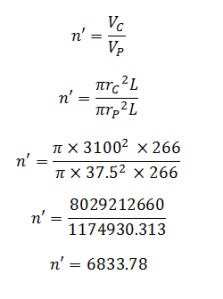
This brings the number of Pringles Cans in a cross section up by over 1000, which seems dramatic and makes Engineering Tool Box’s calculator seem inaccurate. But remember, (n’) is the total Pringles Cans we could fit into a cross section perfectly without remainder. Since circles/cylinders don’t tessellate we’ll never be able to completely fill the cross section in this way and there’ll actually be a lot of wasted space in between the Cans. Wasted space to the tune of over 1000 Cans? Well, that sounds about right actually…

I’ll therefore trust Engineering Tool Box’s calculation of  n = 5346.

CIRLCES4

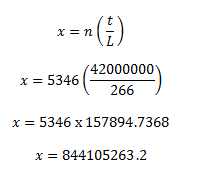
So now we know how many cans we can get in a cross section, we need to know how many cross sections we can get in the entire tunnel. We know the length of a Pringles Can occupying 1 cross section (L) is 266mm. We also know the total tunnelling (t) equates to 42km therefore to find the total number of Pringles Cans in Crossrail (x):
CIRCLES5

You could get a whopping 844 million cans of Pringles in Crossrail!

So with 90 chips per can… How many Pringles could you fit into Crossrail? Answer:

= 75,969,473,684

That’s nearly 76 Billion Pringles!

Some additional fun:

To fit 76 billion Pringles in Crossrail it would cost you £2,093,381,052.63 in Pringles

2000px-Crossrail.svg

… that equates to £49.8m of Pringles per km…

…or the same GDP as San Marino.

If you stacked the Pringles Cans on top of each other you’d build a tower 224,532km high. That’s just over half way to the moon.

All those Pringles would weigh 160,380 tonnes…

…that’s the equivalent to 12,679 New Routemaster Buses or 891 Tube Trains (Central Line).

If it took you 4 seconds to eat a single Pringle it would take Crossrail’s entire 10,000 strong team 352 days* to eat their way through the tunnels.

crossrailcat

If you did it solo it would take over 9000 years of continuous eating!

References:

Crossrail Facts
Engineering Tool Box
Packomania
Matthew Dehgan
Crossrail Logo: By SVG by @assanges ‧ talk – meta – enwp – zhwp – wmhk (Transport for London – [1]) [Public domain], via Wikimedia Commons
San Marino: By Zscout370 (Own work: http://www.consigliograndeegenerale.sm) [Public domain], via Wikimedia Commons
92 Stock: By tompagenet (Tom Page) (http://www.flickr.com/photos/tompagenet/303824827/) [CC BY-SA 2.0], via Wikimedia Commons
Moon: By Gregory H. Revera (Own work) [CC BY-SA 3.0 or GFDL], via Wikimedia Commons

*thanks knighty for correcting me on that one

CycleLine: Another Mad Idea

Yesterday, The Guardian published this article about the Gensler led design to turn London’s abandoned tube tunnels into underground cycle lanes.

https://twitter.com/AndyPCarter/status/563511506394812417

As you can see, this didn’t really strike a chord with me. So as a response – here’s why:

Proposed Route Image from Gensler

Closed

As I discovered when I visited Aldwych Station a year ago, The former Piccadilly line between Holborn and The Strand originally closed as it was deemed uneconomically viable to refurbish the lifts (to the tune of £3m in 1994 money) to cater for the low patronage of 450 passengers per day. Presumably this stance would have to be reversed if the Cycle UnderLine were to provide access to the street at Aldwych, with additional lifts being required at Holborn. Even though I’m sure it would be hoped that more than 450 people per day use the stretch as a cycle lane, this still doesn’t warrant such a big expenditure just to remove cyclists from 0.3 miles of Kingway (the road above). As the whole point of cycling in London is to beat the traffic, and considering that you can walk from Holborn to Aldwych in 6 minutes, I’m not convinced this would save anyone any time. If anything it would make your journey longer.

This video really annoys me – Firstly because an example taxi journey of Green Park – Aldwych is somehow being compared with a cycle journey between the Isle of Dogs – Greenwich. The later of which is 1.2 miles shorter. Secondly – YOU’RE NOT SUPPOSED TO CYCLE IN THE GREENWICH FOOT TUNNEL!

The stretch of tunnel from Green Park to somewhere underneath Strand, East of Charing Cross, was part of The Jubilee Line up until 1999 when the line was extended towards Stratford. Again, it was considered a waste of money to keep this short branch open when Charing Cross was already being adequately served by the Bakerloo Line in a similar direction. Again I’m not sure that a cycle-bypass is really needed here, as you could easily use The Mall and Green Park to safely avoid the bulk of the area’s traffic. Further more, I’m not convinced using the entire proposed tunnel as a continuous route (Holborn – Green Park) would be an effective use of time. If you’re a serious cyclist, you’d just stay at street level on Shaftesbury Ave, and if you’re a novice – well you’d just take the Piccadilly Line and be there quicker.

Capacity & Cost

OK, so this design is at least trying to think of ways to reuse our redundant underground spaces practically, it just isn’t a very well thought out idea. There’s nothing wrong with the concept of underground cycle lanes, in fact as blue-sky thoughts go it’s not half bad. The problem is it’s being applied to a mismatch of routes and tunnels that weren’t even very useful as railways. For this scheme to work you’d have to construct a completely new route, east-west or north-south (A Cycle Crossrail if you will) to really provide congestion relief and a safer, quicker passage for cyclists. With London’s subterranean space now at such a premium, to make any new tunnelling cost effective it really needs to be allocated to high-capacity railway – most likely to a National Rail standard. Look at the proposed Crossrail 2 route. This was originally to be a Tube line from Epping – Wimbledon, but to make the most of any proposed new tunnelling it will now be linked to Suburban National Rail Lines to maximise every last drop of capacity. With all the best will in the world a brand new cycle-only tunnel would not be used as much as a railway or tube line, let alone one that doesn’t connect anywhere useful like Gensler’s.
The question also has to be raised, how would the conversion to cycle lane, the additional lifts and tunnelling be paid for? And how are costs recouped once constructed? You can’t charge cyclists for it’s use. They’d just stay on the streets above if you did. You’d have to look at some kind of commercial sponsorship or combined commercial use as the video suggests. Are shops with cycle-only footfall viable? I don’t know. Maybe in a utopian society, but in London probably not. So then you’d have to open access to pedestrians… and the whole scheme is closer and closer to circling the drain.

Recycling

The idea of recycling space is still nonetheless a good one, so how can we use these redundant spaces more practically? Excellent question.

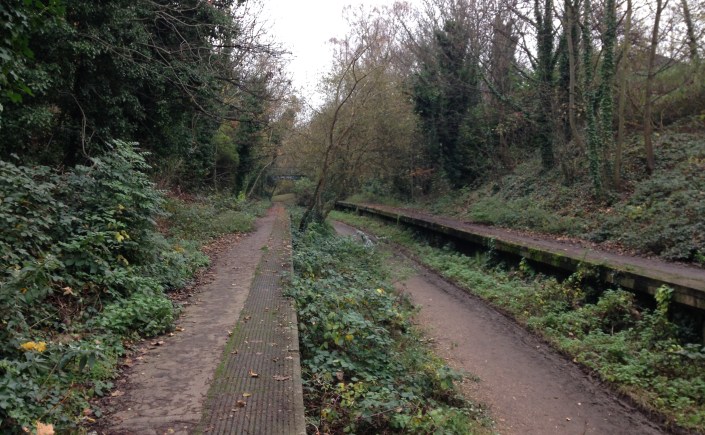
Seeing as both sets of tunnels are still electrified and maintained by London Underground it seems fairly sensible to keep them as railways and try to improve their fortunes. From the early 20th century it was suggested that the Aldwych branch should be extended southwards to Waterloo and beyond. I’ve suggested this myself before as it would alleviate congestion on the Northern Line, and provide a new north-south tube tunnel – of which there aren’t enough.

Image by London Reconnections

As for the Charing Cross tunnels, these have long been mooted as a potential DLR extension from Bank to free up capacity on the Central Line (known as the Horizon study).

Both lovely ideas, but again not without their downfalls: To extend the Piccadilly Line southwards would require an expensive rebuild of Holborn. As London Reconnections point out extending the DLR west would create all sorts of capacity problems at Bank not to mention overuse on the rest of the Dockland’s Network as well. Nevertheless, although more expensive, both ideas above would provide far more lasting capacity per £ over Gensler’s UnderLine.

New York Transit Museum Station. Image by Marcin Wichary

I however think there’s a better way to recycle the tunnels. Make them part of the London Transport Museum. This was recently done at New York’s equivalent where the platform levels are able to showcase rolling stock and past station architecture. You could use the remaining tunnels for exhibits, cafe/retail spaces or even heritage runs of old stock!

Exploration: The Northern Heights

The Edgware London & Highgate Railway opened in 1867. It was almost immedately taken over by The Great Northern Railway and ran services from Edgware, High Barnet and Alexandra Palace to Finsbury Park via Highgate and then onto Moorgate on what is now the Thameslink Northern City Line.

In 1933 it was announced that the line would be amalgamated into London Underground’s Northern Line as part of The New Works Programme and the entire route was to be electrified during the 1930’s. The scheme became known as ‘The Northern Heights.’ Quick and efficient electric trains would then serve the line to The City, as well as the West End, via a newly constructed tunnel linking the line with the tube network at Archway.

Continue reading