On the wall of Britain’s National Railway Museum in York, you can find a display of what might be considered wall art, might be thought of as ingredients in a transport company’s corporate identity, or maybe considered neat graphic design turned into cast metal components. It’s all three, and here it is:
Depot plates at the National Railway Museum in 2013. From left to right, top to bottom; row one: Buxton, Eastfield and Knottingley; row two: Cardiff and Crewe Diesel; row three: Stewarts Lane, Stratford and Hither Green; row four: Immingham and Grangemouth; row five: Toton. There were further plates, not illustrated here. Photo by Paul Wright [used with permission]
These are depot plaques, cast aluminium plates which were part of the best British Rail corporate identity of them all. Each one represents a different Railfreight depot, using local history and motifs to inform their design.
It’s long been my intention to do a piece on combining two interests. Railways and Geocaching. What is Geocaching? – I hear you cry. Well to save me the long explanation I’ve lifted this straight from the official Geochaching website (http://www.geocaching.com):
Geocaching is a real-world, outdoor treasure hunting game using GPS-enabled devices. Participants navigate to a specific set of GPS coordinates and then attempt to find the geocache (container) hidden at that location.
When you find the cache, sign the logbook and return it to the cache. You can take an item from the cache if you like – just make sure to leave something of equal or greater value in its place. When you are finished, put the cache back exactly as you found it, even if you think you see a better spot for it. Finally, visit the cache page to log your find and share your experience with others.
Now you’re all up to speed, I can get onto the interesting stuff. How do you combine Geocaching and Railways?
Geocaches come in all shapes and sizes, but all feature a log book and app listing.
Geocaching guides you to places you don’t often go, to streets you wouldn’t normally need to traverse and to areas of an otherwise familiar city you never knew existed. Whilst I’m a massive advocate of exploring and investigating railway infrastructure and architecture, it can be said a little guidance in choosing which stations and lines to see is always helpful. That’s where the Geocaching site The Side TrackedSeriescomes in (not to be confused with the former sub-blog on this site!).
People all over the world have combined Geocaching with their love of railways and hidden caches at, or nearby to, stations.* Each cache listing also contains a potted history of the location (in this instance the station or line itself) so you’ll learn something too.
*The rules of Geocaching state that all caches should be hidden in safe and publicly accessibly locations and strictly prohibits trespassing on private or unsafe locations. Meaning no caches will be hidden on actual railway land. For more details on how to hide and search for caches safely see Geocaching.com or Side Tracked Series guides.
The Geocaching adventure I have chosen will take me on a journey of the northern portion of “The Hainault Loop” on London Underground’s Central Line. Although the line is only a few miles from my flat it’s but one I rarely have to use, and is a perfect example of using Geocaching as an excuse to visit the unusual or unfamiliar. The line contains 3 of the last used stations on the entire London Underground network, but rather conveniently all host caches nearby. Whilst it’s considered unsporting to show or describe the actual final location of the hidden cache I can still talk about the experience on a whole and it’s the perfect opportunity to exhibit this unusual part of the Underground network.
Hainault
The journey starts at Hainault. Although a through station, most services terminate here from the city. Only a handful an hour continue round to rejoin the Epping branch at Woodford.
The station, which opened in 1903 with the line from Woodford – Ilford, now features an odd hotchpotch of architectural styles. The original platform 1 canopy seen above survives largely unaltered from it’s Great Eastern Railway days.
Post-war developments, and the electrification of the line as part of London Transport’s New Works Scheme, saw the original Platform 2 demolished to make way for the above island platform which sports an of-era Art Deco style waiting room. A quick check of the clocks may be a clue as to why that train that’s only advertised as a minute away seems to take much longer than 60 seconds…
The island platform also features some striking brutalist concrete lamp posts and roundel supports.
Outside at street level the station is a more modest affair having been rebuilt in the 1940’s to accommodate the third platform and the newly built rolling stock depot.
The cache (SideTracked – Hainault) is hidden not far from where I’m standing in the above shot, and was a relatively easy and inconspicuous find. We move on one stop in a geographically westerly direction towards Woodford.
Grange Hill
Despite physically heading west, and depending on the time of day, it is possible to travel on an “eastbound” train (one that will continue towards central London) in either direction from stations between Hainault and Roding Valley. This is evident from the platform route maps bellow which omit the usual compass-point directional information. To avoid operational confusion, train operators and controllers will refer to journeys from Leytonstone -> Woodford via Hainault as “the inner rail” and journeys from Woodford -> Leytonstone via Hainault as “the outer rail.” Any services between Woodford and Leytonstone via Snaresbrook are considered as east or westbound in the normal manner.
For passengers however, the signs are somewhat misleading as they imply that all trains ultimately continue to Central London regardless of platform. In reality most trains on platform 1 will terminate at Woodford and only a handful will continue to the city in peak-hours. It could therefore be quicker to travel via Hainault if this train arrives first… As this and the following 2 stations are some of the least used on the network I highly suspect the locals have figured out the most efficient routes and pay no attentions to the signage anyway.
Grange Hill is located not much more than half a mile from Hainault, and the western ends of the traction depot there can be seen to the top right of the picture bellow.
Up at street level and Grange Hill is similar to Hainault in it’s unimposing post-war image. The original station here, which closer resembled Chigwell (seen later), was damaged by a Doodlebug during the Second World War. Even in 1949 when this façade was constructed, the architectural style was still drawing on Art Deco design principals laid out by Charles Holden some 20 years previous.
The cache here (SideTracked – Grange Hill) is well hidden, or at least it was well hidden. It’s not uncommon for caches to go missing through human error – a previous geocacher may not have replaced the cache properly, or someone not in the know could have dismissed it as rubbish and taken it away. More often than not natural damage, be it high winds or heavy rain, will render a cache irretrievable. Sadly this was the case at Grange Hill, and whilst it’s normally bad form to show a cache’s location, the bellow is an example of what can occasionally happen. Nevertheless it’s an illustration of the cunning way geocachers disguise their physical caches!
Quite evident the log-book was once attached to this fake leaf but it’s sadly no longer anywhere to be seen. If this happens, use the app to request maintenance from the owner.
Grange Hill itself is on the very fringes of rural Essex. The houses here have that very familiar London-suburban feel yet are set neatly around this village Green. A parade of faux-tudor shops line Manor Road behind us. It’s almost easy to forget this place has anything to do with London at all were it not for the block of flats being built next to the station…
Chigwell
After leaving Grange Hill we plunge into Essex proper as the line makes it’s way towards Chigwell.
The station here, as with Grange Hill and Hainault, dates back to the lines opening in 1903. Minor alterations have occurred throughout the years, such as the reduction in platform canopy width, but it still retains most of it’s former GER charm.
It’s difficult to say these stations feel as rural as their setting – Chigwell certainly stands alone as a village in Essex rather than being part of the suburban sprawl. Yet the design of the station definitely looks more suburban than rural, and the shots above and bellow in particular show how much capacity it could support. The whole loop was built with London’s expansion in mind and anticipated traffic that simply didn’t exist at the time. This was a common practice for the railways in the early part of the 20th century, constructing lines that would encourage development and fulfil it’s own existence – Look at Metroland where The Metropolitan Railway not only built the line but the houses and estates that it served. The 1903 Hainault Loop took on a similar approach of constructing stations in open countryside in the hope that developments would follow. For the most part, and certainly between Ilford and Barkingside these estates did come. However, on the northern portion of the loop, the speed of housing construction was lacklustre. In fact Hainault itself was closed for most of the 1910’s due to non-existent patronage. With the need for large scale affordable housing after the Second World War, the estates did eventually get built but not on the scale that the GER had once hoped. As a result it’s easy to see just how over-provided-for Chigwell is now…
The line is served by the 8-car 92 stock units of the Central Line. Despite the fact I could count the number of people exiting the station on one hand there is an abandoned stretch of platform at the eastern end which could have, but never did, accommodate even longer trains!
Back on the cache trail we leave the station. Chigwell is the last remaining example of this type of GER design after both identical Grange Hill and Newbury Park were replaced after the war.
Chigwell really is a world away from the hustle and bustle of London. The cache is located a short walk away from the main building and the route takes us past the former 6 railway cottages which would have housed the station’s general staff.
I’m particularly fond of the mini canopies above each door.
The cache (SideTracked – Chigwell) takes us back over the railway and allows for a good view of the whole station including the abandoned eastern ends.
The cache is easy to find but requires stealth as not to arouse suspicion on the busy road. Many caches are hidden almost in plain site so it’s easy to look a bit odd when rummaging around for them. Remember, caches should always be hidden in publicly accessible areas though and although it’s fun to treat Geocaching as a secretive Mission-Impossible activity, should anyone ask would you’re up to it’s OK to tell them!
With the log-book signed, it’s back to the station.
We had been thus far trying to time our cache hunts between the infrequent Woodford services. The extra time required to find the Chigwell cache meant we were out of sync…
Time at least to admire the flowers…
…and discover that Big Brother is still watching…
Roding Valley
Roding Valley is the odd one out in the group of stations I’ve visited in this post as it was funded and built by a local housing developer in 1936 long after the line had already been constructed. This explains the rather different design and the far more conservative provision of facilities – the platforms are narrower and the rebuilt 1949 station buildings and canopies more minimal.
The connection with the Epping branch that takes trains towards Woodford can just be seen on the horizon of the above photo. In fact the station’s small catchment area owing to it’s close proximity to Woodford, coupled with it’s irregular service, makes Roding Valley the least used station on the entire Underground network. It musters at it’s peak just 500 return journeys every day.** Although we managed to catch it at a particularly busy time…
The 1949 buildings are simple affairs but still have managed to retain some lamp fittings of the time. This is one of the few stations on the network not to have ticket-gate lines.
It could be surprising to think this section of line was the first on the Underground to have Automatic Train Operation in the 1960’s. It’s light usage proved ideal to test the automation system that would go on to be used on the Victoria Line.
The cache is located just outside of the London Borough of Redbridge by one street. Despite technically being in Essex the surrounding area looks decidedly more suburban than the previous two stations.
Last time in the DCC Fitting series I looked at the Bachmann Class 03, and although it was a breeze to fit the chip, the performance left much to be desired. Let’s have a look at what’s next in line:
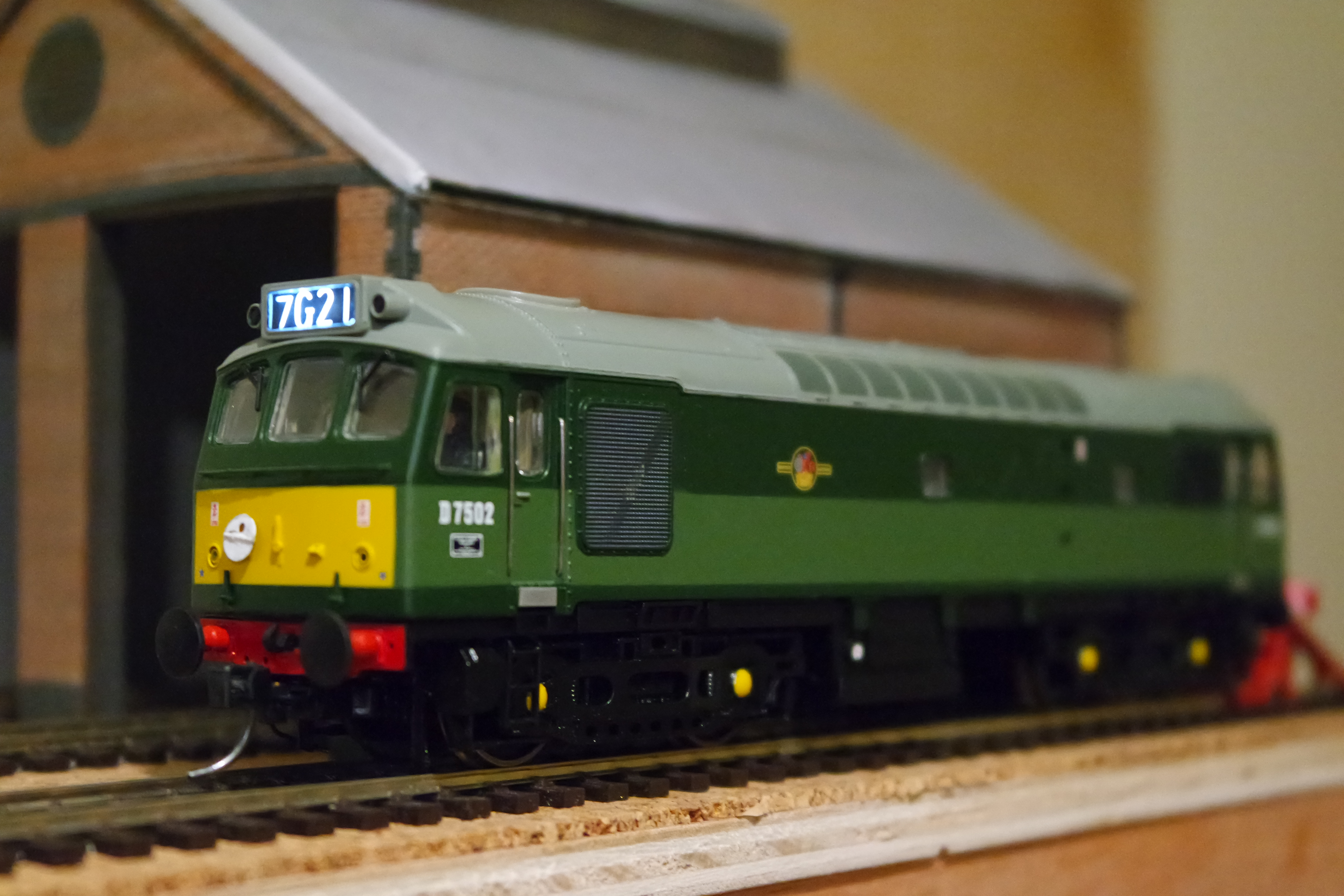
Class 25 by Bachmann
Bachmann really know how to make a good motor mechanism and on analogue, like the 03, this was one of my top 5 runners. More on that later, let’s start with the fitting process:
Bachmann Class 25 in BR Two Tone Green
How Easy Is It To Fit?
I’m happy to report that like the 03, this too is a doddle to get into… Simply remove the 4 screws shown…
Remove the 4 screws with a micro Phillips screwdriver
Hold the under-frame steady, and the body should come right off.
Body Removed
Bromsgrove Models talk of an 8-pin socket and also adding some insulator tape between the PCB board and the chassis. My edition however seems to be a later version and accepts a 4 function 21-pin decoder, and needed no further modifications. If you’ve got the 8-pin model, follow the link above for some additional advice.
“REV A” should be facing upwards, with the bulk of the components and pins also on the upper side.
The manual that comes with the loco (and the one that comes with the chip) should also help you figure out which way to insert the chip. It’s also made obvious by the PCB board having a helpful chip shaped rectangle printed on it as a clue.
It’s worth pointing out at this stage that it’s always best to test and address your freshly chipped loco before you put it back together (if possible). In the case of some models, like the 25, you might not be able to test the lights at this stage as the accompanying circuitry detaches with the body.
These contacts connect when the body is screwed back together. Be sure not to bend them in the fitting process.
Carefully place the shell back on the under-frame and replace screws. It’s that simple.
Fitting Score: 10/10 I feel there’s not much that could be done to make this easier, it’s a well designed setup that also doesn’t compromise an excellently detailed model in any way.
How Does It Run?
Once again I’ve opted for a Bachmann EZ Command chip (The 21-pin variant has reference no. 36-557), again on the basis it’s a Bachmann chip it should work perfectly with a Bachmann loco. It’s also the default brand I get given when I ask my local model shop for a 21-pin chip without specifying a make.
This time round I’m not disappointed. The loco, already fairly silky smooth on DC, glides effortlessly over the rails without so much as a whisper. The slow speed performance, which lets face it – is one of the best parts of DCC operation, is incredibly impressive.
The lights shines nice and brightly, yet not too much to burn-out the legibility of the headcode.
Is there anything negative to say? Well not really. I mean if I was being super picky, it would be good if there was a cab light, or if you could turn off the tail lights individually but this is more down to the design of the model rather than the installation of the chip.
DCC Chip/Running Score: 10/10 Even though some Forums shy away from the cheaper Bachmann chip, the combo seems to work perfectly. Job done!
Lights On!
Overall Score: 10/10 This was actually the first loco I chipped. So why didn’t I start the series with this post I hear you cry? I didn’t want to come straight out the starting blocks without a bad word to say for the DCC fitting process, especially as I know that the results have differed wildly. If I’d started by saying everything was hunky-dory then perhaps you wouldn’t have come back! The Class 03 was a good starting point as it instantly highlighted both the good (easy fitting) and the bad (cheap chip giving average performance) of DCC conversion. The Class 25 sets the bar high for DCC conversion. So was it all down hill from there?
The development of my new layout, Woodford Wells, has been an interesting one. Not least for delving into and learning the brave new world of DCC. (Not really new for most of you, but new for some of us!).
So far the DCC construction and design process has been fairly smooth. The track was easy to wire, the control system simple to learn and the point motors (iP Cobalts) work perfectly. I knew that the hardest part of the DCC learning curve would be upgrading my existing rolling stock. I’ve had to open up a couple of locos in the past to upgrade lighting or to trouble shoot faulty motors and it’s never been an easy process. The fear of damaging delicate and expensive scale parts is always prevalent even with older models. This is something to consider when ‘chipping’ stock yourself. Secondly there was also the assumption from myself that once a chip was inside a loco, the performance would dramatically increase…
This series of fitting guides hopes to shed light on how easy it is to fit chips to given locos (starting with the first 5 that have already undergone the upgrade process) and to investigate what the performance is like after the conversion.
Class 03 by Bachmann
For all of these guides so far I’ve had help from Bromsgrove Models, a site with a comprehensive list of DCC fitting guides. I’d recommend studying these before you consider self-chipping any of your own stock.
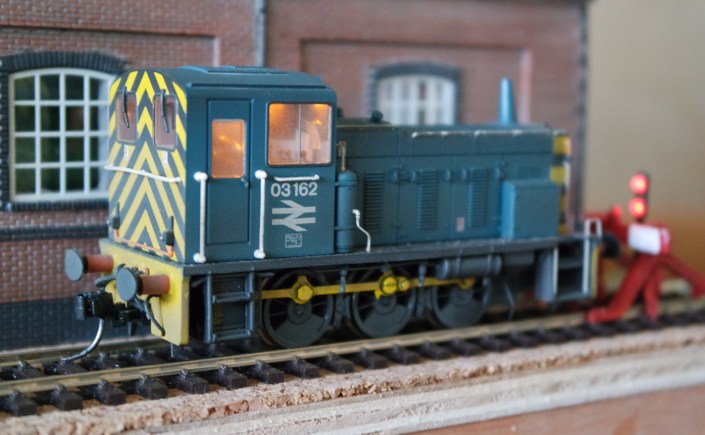
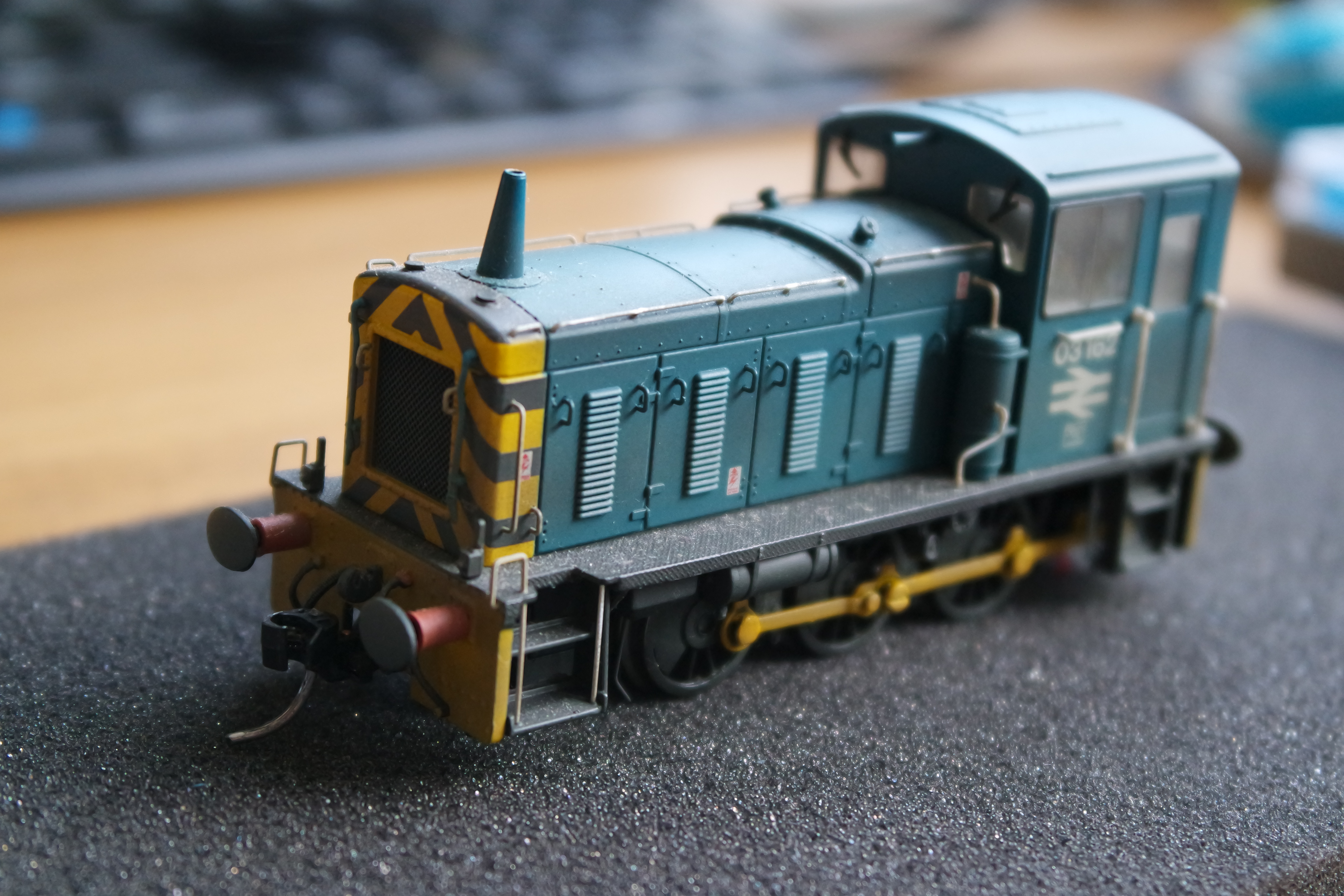
Bachmann Class 03 in BR Blue (Weathered).
How Easy Is It To Fit?
Very. And that’s why I’m starting with this model.
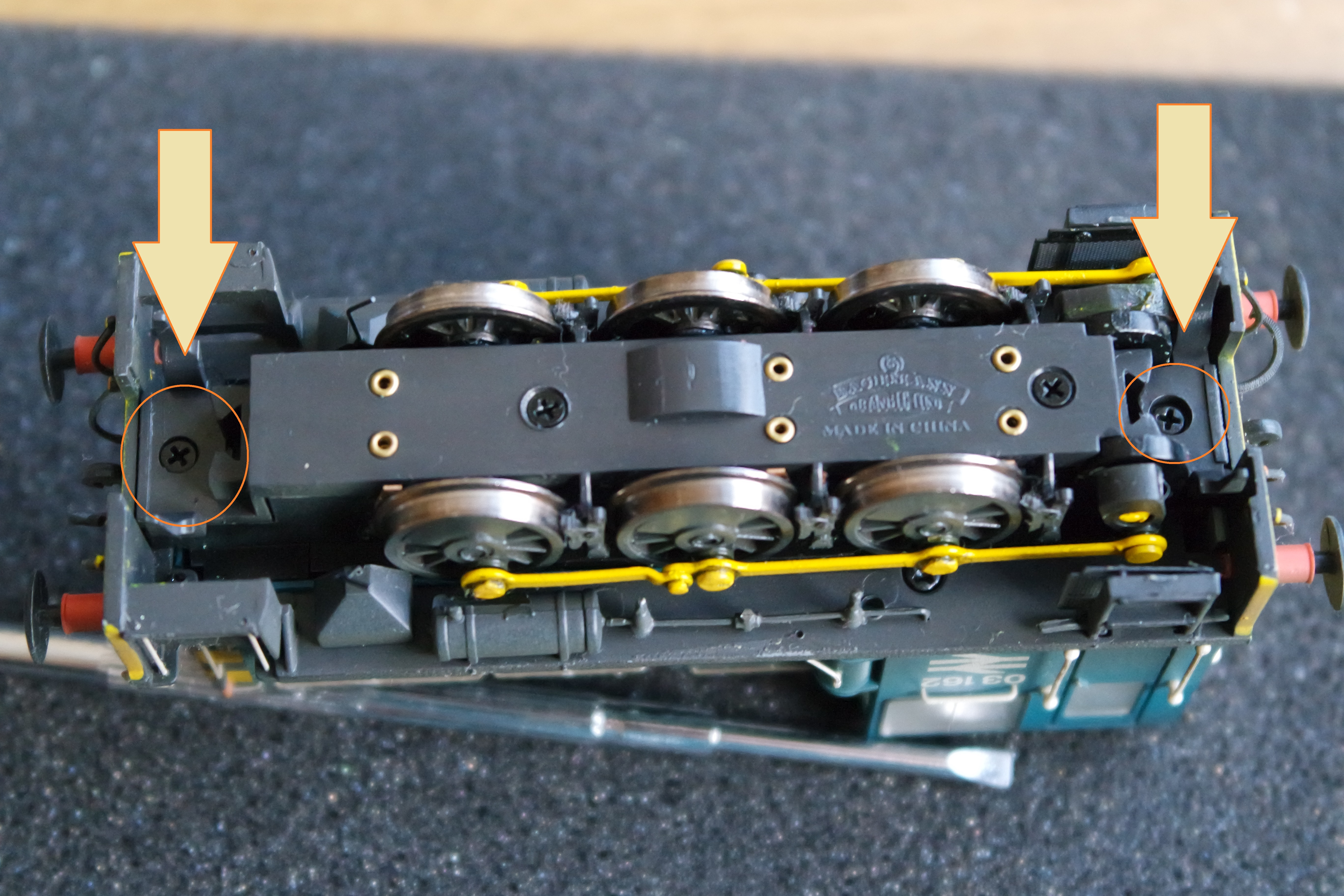
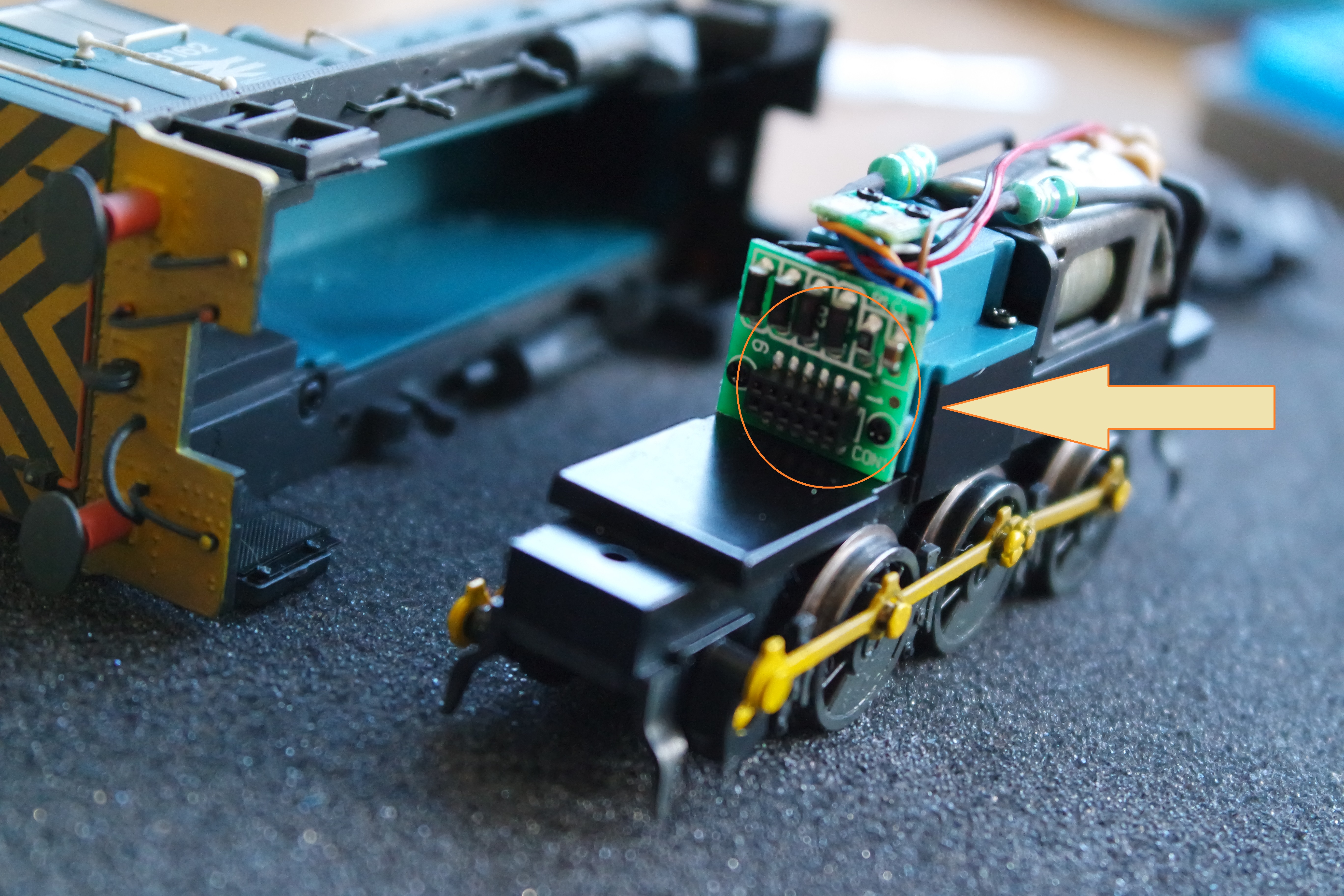
Simply take out the NEM pocket adapters (a small flat head screwdriver will help). This reveals two screws.
Remove the two screws circled.
Remove these screws, and bingo, the body lifts off with ease.
It’s then a matter of fitting the chip. For those not in the know (as I wasn’t but a few months ago) DCC chips comes in a variety of sizes, the most common are 8 or 21. But for some of the smaller locos, like the Class 03, something a little smaller is required: A 6 pin chip. The number of pins a chip has, and do correct me if I’m wrong, directly corresponds with how many functions the decoder can store. A function is a programmable ‘extra feature’ a loco may have beyond it’s motor drive (i.e. directional lighting, cab lighting, sound etc). The more pins you have, the more functions the chips seem to accommodate. Most of the time locos only come with the need for 1 additional function – lights. This is just as well as the chip I’ve bought – the Bachmann E-Z Command 36-558A – can only accommodate 1 additional function, but that’s all I need at this stage.
Pin 1 is identified by a small white square.
Make sure you fit the chip the right way round. Pin 1 (above) must align with socket 1 which is at the right-hand edge of the strip (bellow). All chips should tell you which pin is pin 1.
Pin 1 on right-hand side. Click to enlarge.
Refit the body and NEM pockets and you’re good to go.
Fitting Score: 9/10. Dead easy, just make sure you fit the chip the right way. Not as obvious as a 21 pin decoder, but it’s hard to get wrong.
How Does It Run?
On Analogue the Class 03 was one of the best (if not THE best) performers I had. The gearing is set up in such a way that you can crawl along the track on DC accurate to real life. It was like moving on silk it was that smooth of a mechanism. The Class 03 was high on my list of locos to get chipped when I started the new layout and I instantly had high hopes in terms of making that silky smooth performance even better.
I was quite disappointed.
The ultra-low speed operation is now jerky and uneven. It smooths off a bit when you get to the locos lower-mid range (perhaps a scale speed of 6-8 mph), but even at this pace it’s not quite as good as it once was on DC.
This is when I discover, with a little research, that there are differing premiums of chip. I wrongly assumed a chip would be a chip – how much can one manufacturer differ from another?! – and that a Bachmann at least one would work perfectly in a Bachmann model. Forum trawling highlights that many folk struggle to find a kind word to write about Bachmann’s 6-pin chip, and sometimes struggle to find anything nice to say about Bachmann chips full stop. I certainly have come to learn quickly from the fitting of the other 4 locos I’ll eventually do guides for, that the results of Bachmann chips differ wildly. But then this could boil down to the age old “you get what you pay for.” I’ve seen recommendations for Lenz and Zen chips, but as you’d expect some of these come at twice the price of the evidently budget Bachmann one.
Bachmann 36-558A E-Z Command Chip.
DCC Chip/Running Score: 4/10. I say all this without actually trying an alternative chip – I’ll try another decoder and report back, but until then, the Bachmann chip + 03 combo really doesn’t cut the mustard. Don’t get me wrong, it works (and the cab light looks rather smashing all lit up) but I was expecting more. It also causes a problem with push-shunting coaches with sprung loaded NEM coupling arms – I use delayed action Kadee couplers and the jerky behaviour sometimes frustratingly re-couples the knuckles.
Lights On!
Overall Score: 6.5/10. Bachmann are all over the place here. They’ve created a model that’s easy to DCC fit, and for that – for DCC newbies like me – I thank them profusely. However, the chip as far as I can tell is dreadful and doesn’t do a superb model and mechanism justice.
I hope you’ve found this guide useful, please check back soon for more loco fitting advice, oh and if anyone has any other suggestions/alternative chips for the Class 03 – please comment bellow!

![Depot plates at the National Railway Museum in 2013. From left to right, top to bottom; row one: Buxton, Eastfield and Knottingley; row two: Cardiff and Crewe Diesel; row three: Stewarts Lane, Stratford and Hither Green; row four: Immingham and Grangemouth; row five: Toton. There were further plates, not illustrated here. Photo by Paul Wright [used with permission]](https://callingallstations.co.uk/wp-content/uploads/2015/09/depot-plates-at-nrm-may-2013-copy.jpg) Depot plates at the National Railway Museum in 2013. From left to right, top to bottom; row one: Buxton, Eastfield and Knottingley; row two: Cardiff and Crewe Diesel; row three: Stewarts Lane, Stratford and Hither Green; row four: Immingham and Grangemouth; row five: Toton. There were further plates, not illustrated here. Photo by Paul Wright [used with permission]
Depot plates at the National Railway Museum in 2013. From left to right, top to bottom; row one: Buxton, Eastfield and Knottingley; row two: Cardiff and Crewe Diesel; row three: Stewarts Lane, Stratford and Hither Green; row four: Immingham and Grangemouth; row five: Toton. There were further plates, not illustrated here. Photo by Paul Wright [used with permission] 





 Calling All Stations